One Hundred Twenty Conspirators and the Cedar Window Open Three Times Daily Toward Jerusalem
King Darius’s gold signet ring has just pressed into wet clay sealing a thirty-day death warrant against all prayer, yet high in his Babylon upper chamber eighty-year-old Daniel calmly swings open his cedar lattice shutters toward the west.
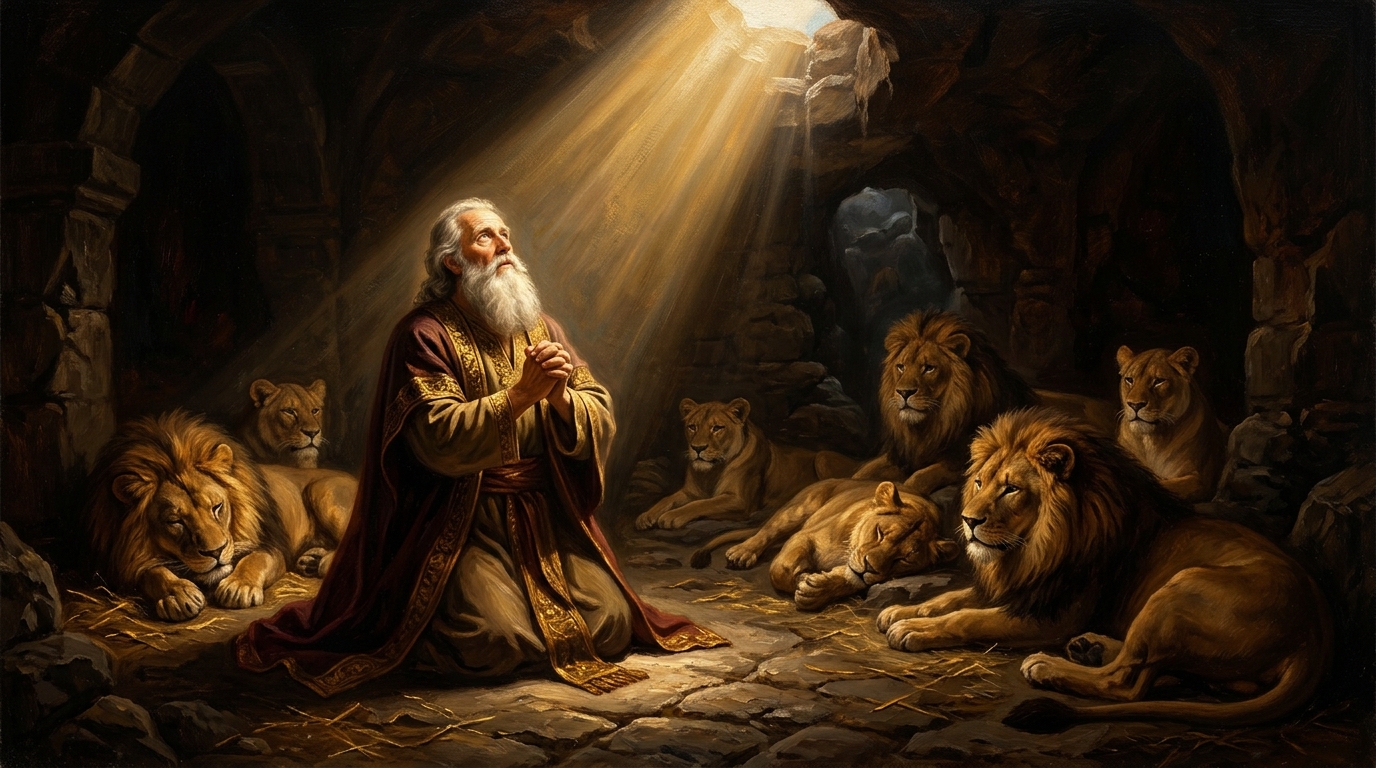 KNEELING DEFIANT FAITH
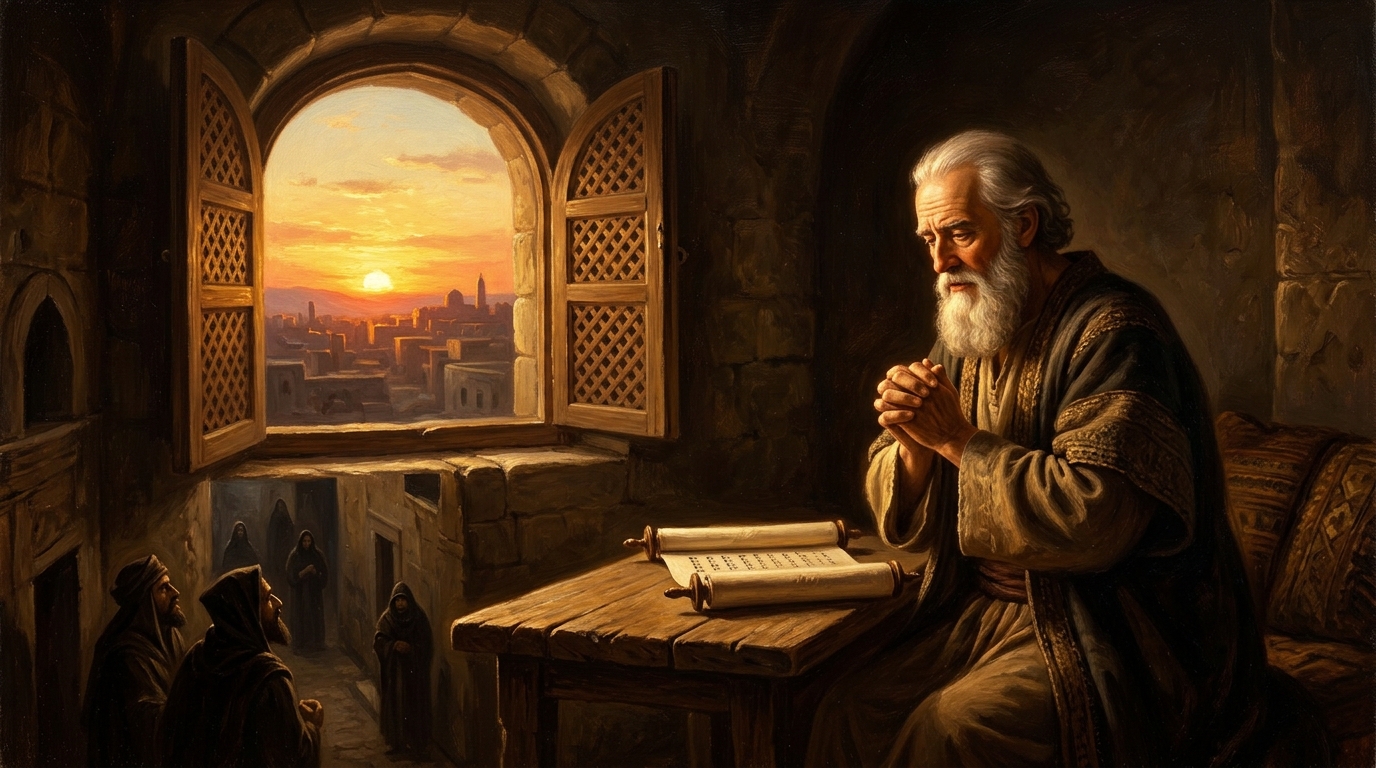
Bronze hinges creaked softly as two carved cedar lattice shutters swung wide to meet the hot afternoon breeze rising off the Euphrates River. Deep crimson Mesopotamian sunlight poured across the upper chamber floor, illuminating the snow-white hair and long beard of a man past eighty years of age. Down below on Babylon’s blue-glazed brick avenues, Medo-Persian royal heralds had just finished nailing King Darius’s newest decree to the city gateposts: for the next thirty days, anyone across all one hundred twenty provinces who dared fold their hands to ask any petition of any god or man save the king himself would be cast alive into the subterranean den of lions. Yet right before that open window facing directly west—where ruined Jerusalem lay more than six hundred miles across the desert—aged Daniel slowly lowered his aching knees onto the woven rug.
Daniel did not pull the cedar shutters closed to whisper his prayers in safe shadows. Nor did he tell himself that at eighty years old, after seven decades of faithful exile service, pausing outward prayer for four weeks would be a sensible compromise to stay alive. Lifting his thin, vein-ridged hands into the golden dusk, he adored and gave thanks before his God with the exact same unhurried peace he had kept three times every day since he was marched into Babylon in chains as a teenager. Seventy years among pagan courts had never dimmed the memory of Jerusalem’s evening incense inside that aged exile’s heart.
One Hundred Twenty Envious Rulers Against a Life Without a Single Stain
To grasp why that single open window shook the Persian court to its foundations, we must step back a few days into the columned audience hall of King Darius. Upon organizing an empire stretching from the borders of India to the Mediterranean Sea, Darius had appointed one hundred twenty satraps to govern the provinces and placed three presidents above them to audit imperial tribute so the king might suffer no loss. Among those three highest officials, the elderly Jewish exile named Daniel shone with such extraordinary wisdom and incorruptible clarity that the king planned to set him over the whole realm.
Scripture notes that “an excellent spirit” was in Daniel. And that very excellence ignited a furnace of jealousy inside his two fellow presidents and the one hundred twenty satraps. Men accustomed to skimming provincial silver, pocketing quiet bribes, and trading favors in dark corridors realized that having an incorruptible eighty-year-old Hebrew as grand vizier meant the sudden death of their plunder. Those who serve God with undivided conscience inevitably serve the public good with a diligence corrupt officials can neither match nor forgive.
So began the most ruthless political audit of the ancient world. Scores of scribes and informers combed through every parchment scroll, every cuneiform clay ledger, every judicial ruling, and every tax receipt bearing Daniel’s seal across decades. They hunted for one missing silver shekel, one nepotistic favor shown to a fellow Judean exile, or one careless oversight of old age. What they found left all one hundred twenty-two conspirators pale with frustration: Daniel’s public record was spotless as mountain snow! He was so faithful to the king and so scrupulous in every duty that no charge or suspicion could be fastened upon him.
The Flattery Trap and the Unbreakable Seal of the Medes and Persians
Huddled behind closed doors by flickering oil lamps, those powerful noblemen were forced to utter a grudging confession that rings across history as the highest tribute ever paid to a believer by his enemies: “We shall not find any occasion against this Daniel, unless perhaps concerning the law of his God.” When a servant of God lives with unimpeachable honesty in daily work, malice has only one weapon left: to make fidelity to God itself a crime.
Knowing full well that King Darius cherished Daniel and would never sign a warrant aimed openly at his friend, the conspirators targeted the oldest blind spot of earthly monarchs—royal vanity. Marching together into the throne room, they presented a flattering proposal wrapped in false unanimity: all the presidents, captains, satraps, senators, and judges of the empire had agreed to ask the king for an imperial statute decreeing that for thirty days whoever asked any petition of any god or man except King Darius should be cast into the den of lions.
It was a brazen lie—for Daniel, the foremost of the three presidents, had never been consulted—yet the incense of flattery blinded the king. Never suspecting that the decree was a dagger aimed straight at his most trusted counselor, Darius slipped the gold signet ring from his finger and pressed it into the soft clay and wax of the royal scroll. Under the iron constitutional law of the Medes and Persians, once the king’s signet sealed an edict, not even the emperor himself could revoke or alter a single syllable.
Why Didn’t Daniel Simply Close His Shutters and Pray in Secret?
The trap was sprung. Exiting the palace in quiet triumph, the conspirators stationed watchers along the street outside Daniel’s house. They knew by heart the sacred rhythm the old man had kept for seventy years: at sunrise, at high noon, and at the hour of the evening sacrifice, Daniel climbed to his upper chamber and opened the lattice window facing Jerusalem, fulfilling King Solomon’s ancient dedication prayer for exiles in a distant land (1 Kings 8:48).
Standing in his courtyard after hearing that the law had been signed, Daniel had every worldly excuse within reach: “God sees the heart in secret; I can simply latch the wooden shutters for thirty days and pray silently under my blanket at night, saving my life and my high office to keep protecting my people!” Yet Daniel saw through the fog of compromise: when an unjust law commands men to treat the state as God, hiding one’s prayer out of fear is no longer modesty—it is public surrender. True fidelity neither courts danger out of vanity nor retreats a single step when conscience is commanded to bow before an idol.
Three Times a Day on His Knees: Giving Thanks in the Shadow of the Pit
So as the late afternoon sun gilded Babylon’s brick towers, the steady footsteps of an eighty-year-old man climbed the wooden stairs right on time. His weathered hands unlatched the upper-room windows facing Jerusalem—where Solomon’s Temple still lay in charred ruins, yet where God’s covenant promise stood unbroken—and he knelt down.
Most breathtaking of all is what Sacred Scripture records next: with hungry lions waiting in the pit below, Daniel did not merely beg for rescue; “he knelt down three times a day, and adored, and gave thanks before his God, as he had been accustomed to do before.” Down in the courtyard, the watching conspirators burst into the house together, caught the old statesman on his knees giving thanks to the Lord, and hurried back to the palace to demand that the lions’ den be unsealed before nightfall. That evening prayer offered on aged knees before the open window was already the victory that would tame the beasts below.
“Now, when Daniel knew this, that is to say, that the law was made, he went into his house: and opening the windows in his upper chamber towards Jerusalem, he knelt down three times a day, and adored, and gave thanks before his God, as he had been accustomed to do before. Wherefore those men carefully watching him, found Daniel praying and making supplication to his God.”— The Book of Daniel 6:10-11
Lord God of the prophet Daniel, You granted Your aged servant clean hands in his daily work and an unshakable heart at his open window of prayer. Bless our family and our home tonight. Whenever the pressures of the world tempt us to shut the windows of our faith or hide our love for You, give us the quiet courage to kneel in Your presence. Teach our children to walk in honesty and to adore and thank You morning, noon, and night. Through Christ our Lord. Amen.
Biblical & Historical Questions Answered
Why did Daniel always open his windows toward Jerusalem when he prayed?
How do Daniel’s three daily prayers connect to Catholic prayer tradition?
Why didn’t Daniel close his shutters and pray silently to avoid arrest?
Carry This Story Into Silent Prayer
Light a free 24-hour vigil candle for someone you love or rest in the candlelit 3D Chapel.