Four Breathless Messengers and the Collapsed Feast in the Land of Uz
The smoke of ten dawn holocausts still hung above the stone altar of Uz when four bloodied servants stumbled through the gate in rapid succession, laying at Job’s feet ten crushed silver chalices dug from the collapsed banquet hall where all ten of his children had just perished.
 TEN BURIED CHALICES
The thick scent of lamb fat searing upon hot basalt still clung to Job’s silver beard. When the sun had barely cleared the eastern ridges of the land of Uz, the wealthiest man in all the ancient East had already stacked ten bundles of cedar wood upon his rough-hewn stone altar with his own hands. Ten whole burnt offerings. One for his firstborn son, another for his second, counting out every one of his seven sons and three daughters. He watched the ten columns of white smoke rise straight against the deep indigo sky with the trembling vigilance of a holy father: what if, amid the laughter and wine at their eldest brother’s house today, one of his children had let a careless or proud thought against God cross the threshold of their heart?
The peace of that morning felt as thick and sweet as wild Edomite honey. Across pastures stretching to the edge of sight, seven thousand sheep with fleece like summer clouds grazed in the dewy grass. Three thousand spice-bearing camels rested beside limestone cisterns, five hundred yoke of oxen turned the dark soil beneath iron-tipped plows, and five hundred she-asses fed quietly in the pens. At every city gate in the East, elders rose and bowed when Job passed—not merely for the weight of his silver, but because he was the shield of widows, a father to the fatherless, and a man who had never let a shivering beggar sleep without the warmth of his own sheep’s wool.
The Unseen Wager and the Question That Tests Every Believing Heart
Yet Job did not know that at the very hour his morning sacrifice ascended, an unseen confrontation had erupted beyond mortal sight. The Accuser—Satan—pointed toward the abundance of Job’s household and hurled the most cynical question in human history: “Doth Job fear God in vain?” The logic of darkness is always transactional: human beings only kneel because the Almighty builds a hedge of protection around their house, multiplies their flocks, andprosper the work of their hands. Tear down that hedge, strike his bone and his treasure, and he will curse You to Your face! A cosmic test was permitted to fall upon the upright man of Uz to answer before heaven and earth a single piercing question: can a human heart love God for God Himself, with zero guarantee of earthly reward?
At high noon, the southern horizon of Uz bruised into a livid purple. A parched gale from the Arabian waste began to scream through the basalt gorges, carrying the metallic taste of scorched dust. Job was sitting beneath the cedar awning of his main tent when the frantic pounding of bare feet shook the packed earth. A plowman burst through the courtyard gate, his throat raw with thirst and his shins torn by desert thorns. Too breathless even to kneel, he gasped that Sabean raiders had swept across the border like a sandstorm, put every farmhand to the sword, and driven off all five hundred yoke of oxen and five hundred she-asses. Only he had escaped by hiding beneath the carcass of a slain ox.
Job’s hand was still extending a clay water jar to the trembling plowman when the western gate was flung open with a crash. A second shepherd collapsed face-down onto the stone steps. His eyebrows and coarse linen tunic were singed black, reeking of charred wool and sulfur. Pointing with blistered fingers toward a boiling wall of black thunderheads in the west, he sobbed: “The fire of God fell from heaven!” A relentless barrage of lightning had struck the dry pasture valley, turning seven thousand sheep and every young shepherd into a sea of glowing embers within minutes.
Four Bloodied Messengers and Ten Silver Chalices Beneath the Fallen Roof
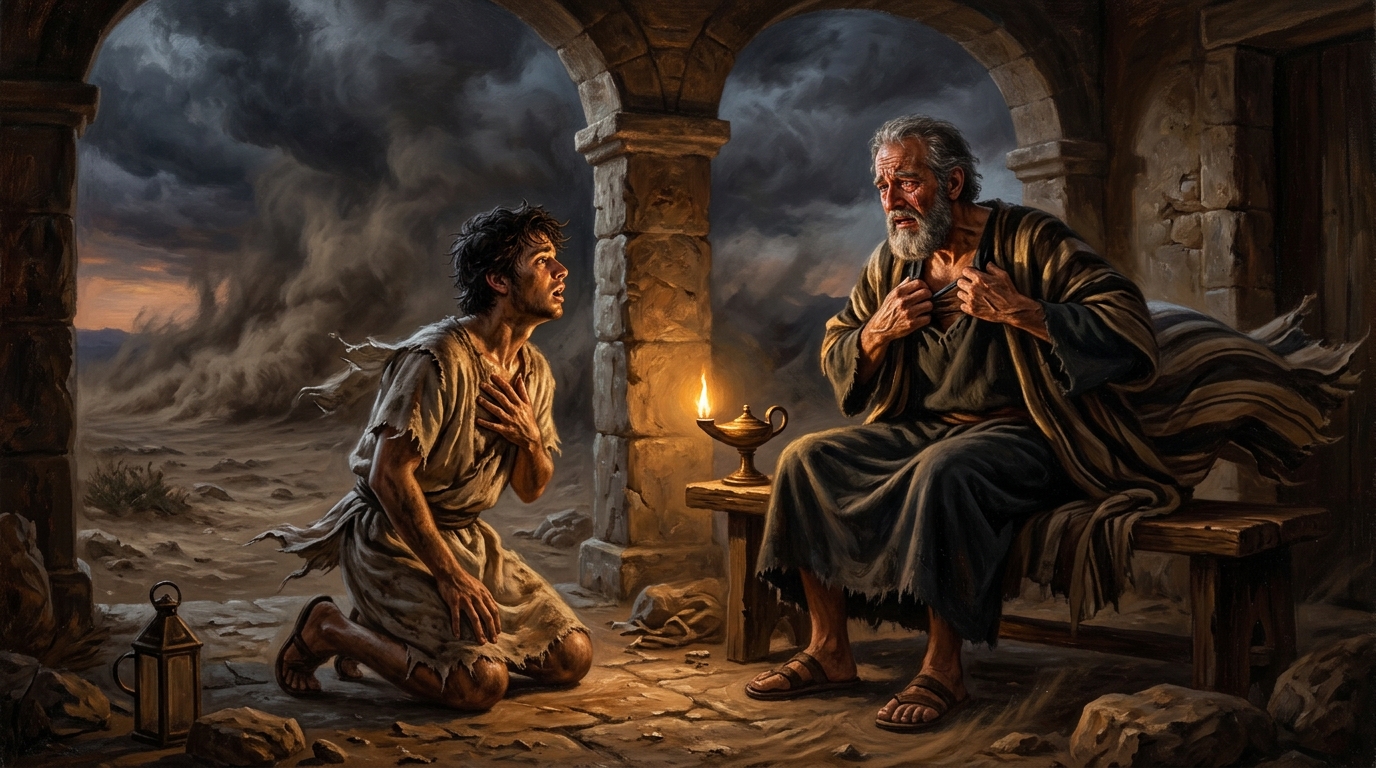
Before the echo of that cry could fade across the courtyard, a third messenger staggered through the arch, clutching a bleeding saber gash across his left shoulder. Three squadrons of Chaldean horsemen had ambushed the northern caravan trail, seized all three thousand camels, and slaughtered the guards to the last man save him. Within less than an hour, the wealth of a lifetime—flocks, plowlands, caravans, and faithful servants—had vanished like a drop of water hitting red-hot iron. Job’s hands went ice-cold, yet his eyes remained fixed on the windswept courtyard. His ten children were still alive. So long as his seven sons and three daughters breathed, he could pick up a shepherd’s staff and begin again from nothing.
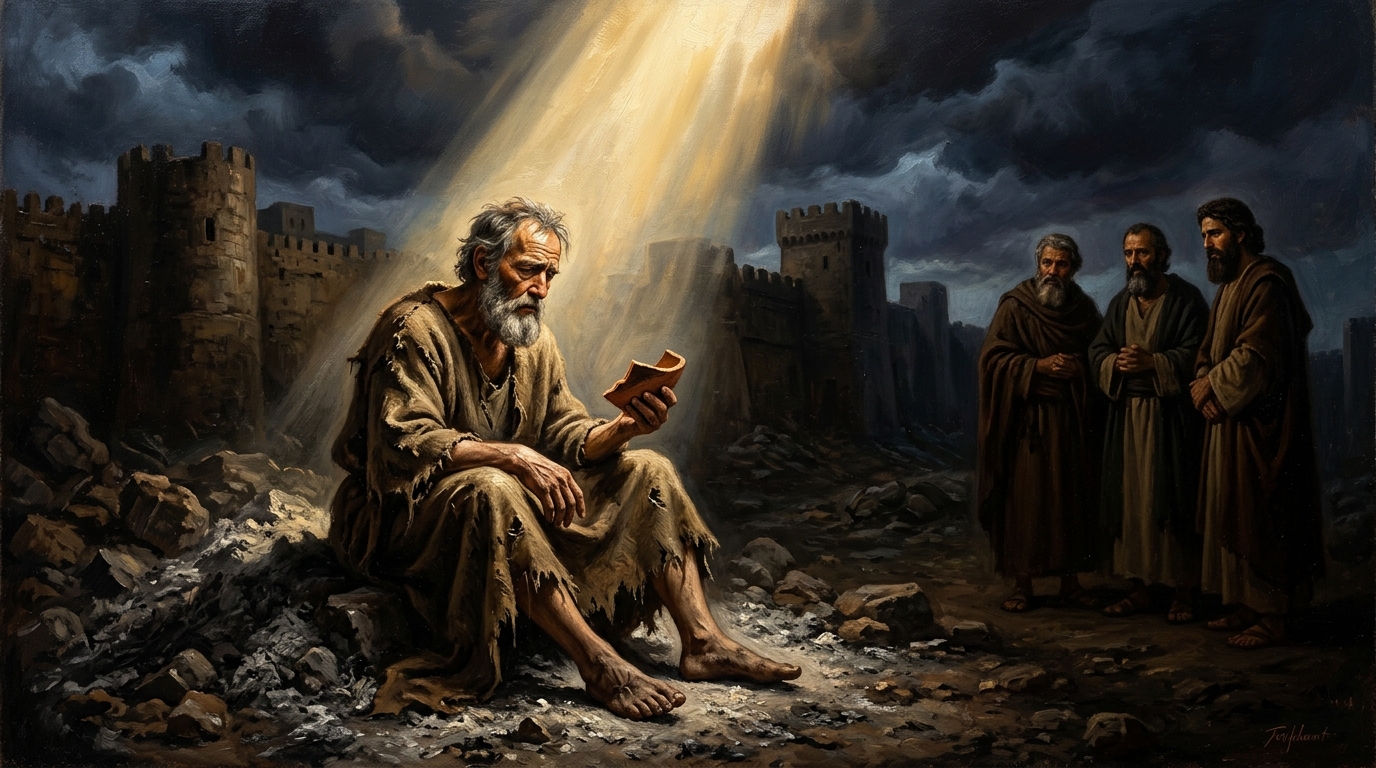
Then the fourth man crossed the threshold. The old household steward was not running. He walked with the dreadful slowness of a man carrying a coffin, clutching against his chest a linen cloth stained with dark blood and white limestone dust. When he dropped to his knees before Job, the bundle unfolded across the flagstones. Out rolled ten silver banquet chalices—every single cup crushed flat, twisted out of shape, caked with crimson mud and mortar shards. Beside the battered chalices lay a jagged broken potsherd of baked red clay, a fragment from a shattered wine jar in the firstborn’s house.
The old steward’s voice cracked like splitting stone: while the seven sons and three daughters were eating and drinking wine together around the table in their eldest brother’s house, a monstrous desert whirlwind had roared across the wilderness and struck all four corners of the stone building at once. The cedar roof beams snapped in two. Tons of dressed limestone masonry crashed straight down upon the banquet hall in the middle of their feast. Not a single cry escaped the ruins. All ten vibrant sons and daughters for whom Job had offered ten holocausts at dawn now lay lifeless beneath a mountain of silent stone.
When the Altar of Dawn Meets Ten Fresh Graves at Sundown
The air in the courtyard of Uz grew so heavy that no servant dared draw breath. Women in the household compound began to wail, tearing their hair and flinging dust into the wind. Every terrified eye turned toward the aged father standing frozen above the ten crushed silver cups. This was the exact second the Accuser had wagered upon: the moment when a man stripped of everything before sundown would shake his fist at the sky and scream that God was a liar and that the morning altar had been a cruel mockery.
Slowly, Job rose from his seat. The broad shoulders of the eastern chieftain shook with a silent convulsion. He gripped the collar of his woven mantle and ripped it from throat to hem in a single tear. Drawing the small knife from his belt, he shaved the silver hair of his head—the crown of his dignity among the tribes—letting the white locks scatter into the dirt beside his children’s crushed chalices. Then, like an ancient oak struck through the heart by lightning, he dropped to his knees on the bare ground and pressed his forehead into the dust still warm with the ashes of his dawn sacrifice.
The Blessing from the Dust That Silenced the Accuser
From down in that dirt soaked with the tears of a father bereaved of ten children at a single blow, no curse rose to the sky—only a whispered prayer that shook both heaven and hell: “Naked came I out of my mother's womb, and naked shall I return thither: the Lord gave, and the Lord hath taken away: as it hath pleased the Lord, so is it done: blessed be the name of the Lord.” Job’s fingers closed around the sharp broken clay potsherd in the dust until his palm bled, yet his lips uttered no foolish accusation against the Most High. Before the eyes of all the angels, he had proved that his heart belonged to the Giver, not the gifts.
Yet that night, as ten fresh cairns of stone were sealed beneath the freezing stars of Uz and Job sat alone beside the dying embers of his courtyard, the siege was far from over. The first storm had stripped away everything outside his skin. Before the next sunrise touched the desert ridges, a second blade would strike straight into his own flesh—and borrow the voice of his closest companion to beg him to surrender.
“And said: *Naked came I out of my mother's womb, and naked shall I return thither: the Lord gave, and the Lord hath taken away: as it hath pleased the Lord, so is it done: blessed be the name of the Lord.”— The Book of Job 1:21
Almighty and ever-living God, You heard the brokenhearted weeping and unshakeable adoration of Your servant Job on that afternoon of grief across the plains of Uz. Forgive us for the many times we seek You only when our barns are full and doubt Your goodness the moment a storm strikes our roof. Grant us a heart that loves You without bargain or condition, so that even amid losses our reason cannot fathom, we may cling to Your fatherly hand in steadfast trust. Through Christ our Lord. Amen.
Biblical & Historical Questions Answered
Where was the land of Uz located in the ancient Near East?
Why did Job offer whole burnt offerings every morning after his children’s feasts?
How does the Catholic Church explain why God permitted Satan to test Job?
Carry This Story Into Silent Prayer
Light a free 24-hour vigil candle for someone you love or rest in the candlelit 3D Chapel.