Thunder from the Whirlwind and the Scarred Hands That Prayed for His Accusers
When a pillar of fire and wind splits the sky above Uz, God does not hand Job a theoretical ledger of explanations, but sweeps him across the breathtaking architecture of the cosmos—before entrusting the prisoner on the ash heap with the priestly mission of praying for the three friends who condemned him.
 MY EYES BEHELD
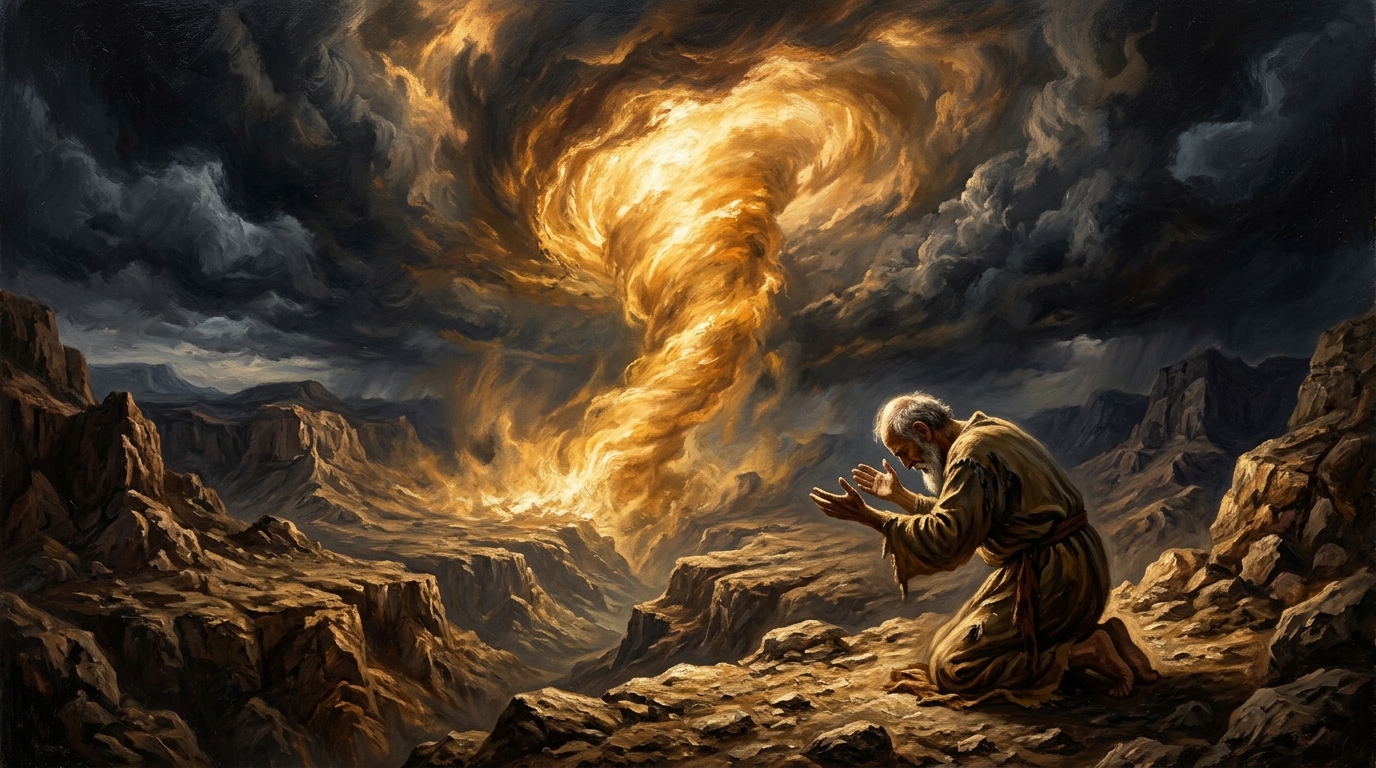
The ground beneath the ash mound outside the walls of Uz began to shudder like the skin of a war drum. The wind ceased blowing flat across the steppe and reared up into a towering vortex joining red desert sand to thunderheads boiling with white lightning. The sharp tang of ozone and hailstone air froze every breath in the courtyard. Eliphaz, Bildad, and Zophar—the three sages who moments earlier had lectured so confidently upon the ways of the Almighty—flung themselves flat into the dirt, shielding their heads with both arms. Out of the core of that roaring funnel, a Voice thundered that made the basalt bedrock tremble.
God Himself had stepped onto the field. After thirty-seven chapters soaked in tears, after countless nights in which Job had stared at a brass sky begging the Most High to break His silence, the Lord answered Job directly out of the whirlwind. Yet the most astonishing detail is that God never once mentioned Satan’s name, nor did He hand Job a courtroom transcript explaining why the sheep had burned or why the roof had collapsed. Instead of answering the question “Why?”, God placed Job before the question “Who?”: “Who is this that wrappeth up sentences in unskillful words? Gird up thy loins like a man: I will ask thee, and answer thou me!”
When the Creator Steps from the Whirlwind and Unrolls the Blueprints of the Cosmos
From the blazing heart of the tempest, the Creator unrolled the architectural blueprints of the universe before the swollen eyes of the man sitting in the ashes. “Where wast thou when I laid the foundations of the earth? Tell me if thou hast understanding! Who hath laid the measures thereof, or who hath stretched the line upon it, when the morning stars praised me together, and all the sons of God made a joyful melody?” Every divine question rolled forward like an ocean breaker, sweeping away the tiny ledger box in which human reason had tried to lock the Infinite.
He led Job’s gaze from the barred gates that hold back the raging sea to the secret chambers where the dawn is born; from the storehouses of snow and hail among the high peaks to the constellations of the Pleiades and Orion bound with chains of light across the deep. He showed him the lioness hunting in the thicket, the mountain goat giving birth alone upon sheer crags without a human hand to assist her, the warhorse pawing the valley before the spears, and the eagle building her nest upon inaccessible cliffs. If mortal man cannot even fathom how rain falls upon an uninhabited wilderness to make tender grass spring from barren stone, or who feeds the young ravens when they cry out from the nest, how could finite reason sit in judgment upon the One who governs ten thousand worlds?
Job was not crushed by terror; he was healed by the loving majesty of God. In a flash he realized that throughout his agony, his deepest torment had not been the loss of flocks or the fire in his skin, but the dread that God had forgotten him or that the universe was spinning blindly without a Father at the helm. Now, beholding the tender precision with which the Creator watches over every fledgling hawk on the cliff, every drop of night dew, and even the great beasts of the abyss without a single creature slipping from His sight, Job’s broken heart awoke: the One who holds the orbits of the morning stars was also holding Job’s ten children and every tear he had shed in the palm of His hand!
The Clay Shard Falls to the Dust: Now My Own Eye Sees You
Slowly, Job’s scarred fingers unclenched. The jagged terracotta potsherd—witness to so many days of scraping blood and bitterness—slipped from his palm and dropped into the gray ash, now softened by the first cool drops of desert rain. Laying his hand across his mouth, he fell to his knees before the radiant pillar of the whirlwind and whispered the noblest confession of a soul that has walked through the dark night: “I know that thou canst do all things, and no thought is hid from thee. With the hearing of the ear, I have heard thee, but now my eye seeth thee. Therefore I reprehend myself, and do penance in dust and ashes!”
Job was not confessing secret crimes he had never committed; he was bowing in reverent awe for having tried to measure the unfathomable mystery of God with the short reed of mortal understanding. And at the exact instant Job humbled himself in the dust, a breathtaking reversal took place. The thunder of the whirlwind wheeled directly upon Eliphaz the Temanite and his two companions trembling on the ground!
The verdict of the Lord rang out clear and stern: “My wrath is kindled against thee, and against thy two friends: because you have not spoken the thing that is right before me, as my servant Job hath!” The Almighty Himself stepped forward as public Vindicator to clear His servant’s name! The polished, self-righteous sermons that blamed the victim were condemned by God, while Job’s raw, bleeding cry from the ash heap was declared the upright prayer of a faithful son.
The Verdict Against the Three Judges and the Prayer That Saved His Accusers
Yet the summit of divine mercy shone in the next command given to the three humbled judges: they were ordered to take seven bullocks and seven rams to Job, so that Job himself might offer a holocaust and pray for them, “for his face I will accept, that folly be not imputed to you!” Silence fell across the plain. Job stood before the final test of charity: the very three men who had trampled upon his paternal grief for days now depended upon his priestly intercession for their pardon. He could refuse them, or look down upon them in triumphant scorn.
Job did not hesitate. Rising from the ash mound, he used those very hands still scarred by boils and cut by the clay potsherd to stack the wood upon the altar, lift the sacrificial cup, and weep in prayer for Eliphaz, Bildad, and Zophar. And Sacred Scripture records a single sentence that illuminates every wounded life: “The Lord also was turned at the penance of Job, when he prayed for his friends!” At the exact moment the wronged sufferer prayed for those who had hurt him, the floodgates of healing burst open. The sores dried and vanished from his skin beneath the morning breeze.
Twofold Restoration and the Secret of the Ten Children Who Never Perished
All his brothers, sisters, and former acquaintances who had stood aloof came streaming back into his courtyard, broke bread at his table, comforted him, and gave him each a piece of silver and a golden earring to rebuild his house. The Lord blessed the latter days of Job with double all that he had possessed before: fourteen thousand sheep, six thousand camels, one thousand yoke of oxen, and one thousand she-asses. And within the rebuilt house on the plains of Uz, God granted him once more seven sons and three daughters, the fairest in all the land of the East.
Why were Job’s flocks restored twofold, while his children were again seven sons and three daughters rather than twenty? The Fathers of the Church answer with luminous wisdom: because the slain cattle had perished forever, whereas Job’s first ten children had never ceased to exist—they were alive in the hands of God awaiting the resurrection! Thus, with ten children in heaven and ten children on earth, Job truly received double in his family as well. He lived a hundred and forty years more, beholding his children and his children’s children to the fourth generation in fullness of peace—an eternal witness that the Lord is merciful and compassionate, and not one faithful tear ever falls into the dust in vain.
“Behold we account them blessed, who have endured. You have heard of the patience of Job, and you have seen the end of the Lord, that the Lord is merciful and compassionate.”— The Letter of Saint James 5:11
God of infinite mercy and compassion, You spoke from the heart of the whirlwind to vindicate the innocence and dry the tears of Your servant Job. We thank You that through the dark nights of life You lead us from a secondhand faith of hearsay into the living encounter of seeing You with our own eyes. Grant us the noble heart of Job to forgive and intercede for those who judged us without understanding our pain, so that Your grace may restore twofold the peace of our homes. Through Christ our Lord. Amen.
Biblical & Historical Questions Answered
Why does God speak about creation and the stars in Job 38–41 instead of explaining Satan’s initial wager?
What spiritual lesson is contained in God restoring Job at the moment he prayed for his friends (Job 42:10)?
Why does Saint Gregory the Great teach that Job received double in his children even though he was given ten more rather than twenty?
Carry This Story Into Silent Prayer
Light a free 24-hour vigil candle for someone you love or rest in the candlelit 3D Chapel.