The Thunder of Bronze Chariot Wheels at Pi-hahiroth and the Dead-End Shore
Trapped between the black rollers of the Red Sea ahead and six hundred chosen war chariots of Pharaoh hurtling down the mountain pass behind them, hundreds of thousands of Israelites panicked in the night and turned on Moses.
 SIX HUNDRED CHARIOTS
The gravel and sand beneath the bare feet of six hundred thousand men began to shudder long before the drumming of horse hooves reached the beach. Beneath the bruised purple twilight of the bay of Pi-hahiroth, tiny pebbles danced across the packed earth to the rhythm of a metallic thunder growing louder by the minute. Six hundred chosen war chariots of the Egyptian empire, backed by every horseman and garrison chariot of the Nile delta, were hurtling full-gallop through the dry mountain defile to seal a gigantic killing ground.
Not a single avenue of escape remained. Directly ahead of the multitude—men, nursing mothers, bent elders, and terrified children—heaved the black, fathomless expanse of the Red Sea, hurling white spray against the rocks beneath the rising night wind. To the right and left of the encampment, the jagged limestone cliffs flanking Migdol and Beelzephon rose like sheer prison walls blocking any flight along the coast. And directly behind their backs, the sole pass leading back toward the wilderness was now choked with a forest of bronze spears, composite bows, and iron-rimmed chariot wheels.
The Death Trap at Pi-hahiroth and the Hardened Heart of Pharaoh
Only days earlier, after the dreadful midnight when every firstborn in Egypt fell dead and the blood of the Passover lamb still glistened dark upon wooden doorposts, Pharaoh himself had driven Israel out of his land in haste. Yet once the initial numbness of funeral grief wore off, the heart of the monarch who worshiped himself as a god hardened once more with greed. Staring at the silent brick kilns and deserted store-cities of Pithom and Rameses, Pharaoh and his royal ministers pounded their fists and cried: “Why have we done this, that we have let Israel go from serving us?”
In an instant, the deadliest war machine of the ancient world was unleashed. When royal scouts reported that the fugitive nation, instead of marching straight up the coastal highway toward Philistia, had wheeled south and pitched camp against the cul-de-sac shore of Pi-hahiroth, Pharaoh laughed aloud—convinced that the former slaves were wandering in confusion and that the wilderness had shut them in. The king himself yoked his gilded war chariot and led six hundred elite chariots—each manned by armored archers and captains—driving day and night to drown the beach in blood or drag Israel back in neck-chains.
When the Israelites lifted their eyes toward the western ridge and saw the towering wall of dust lit red by thousands of blazing torches and bronze spearpoints marching straight down upon them, sheer terror ripped through the camp. Infants wailed against their mothers’ chests, women screamed for their husbands, and startled flocks trampled through tent ropes while the black surf pounded at their heels. The bitter salt spray of the sea mingled with the cold sweat of imminent slaughter.
When Terror Tempts the Soul to Prefer the Chains of Slavery
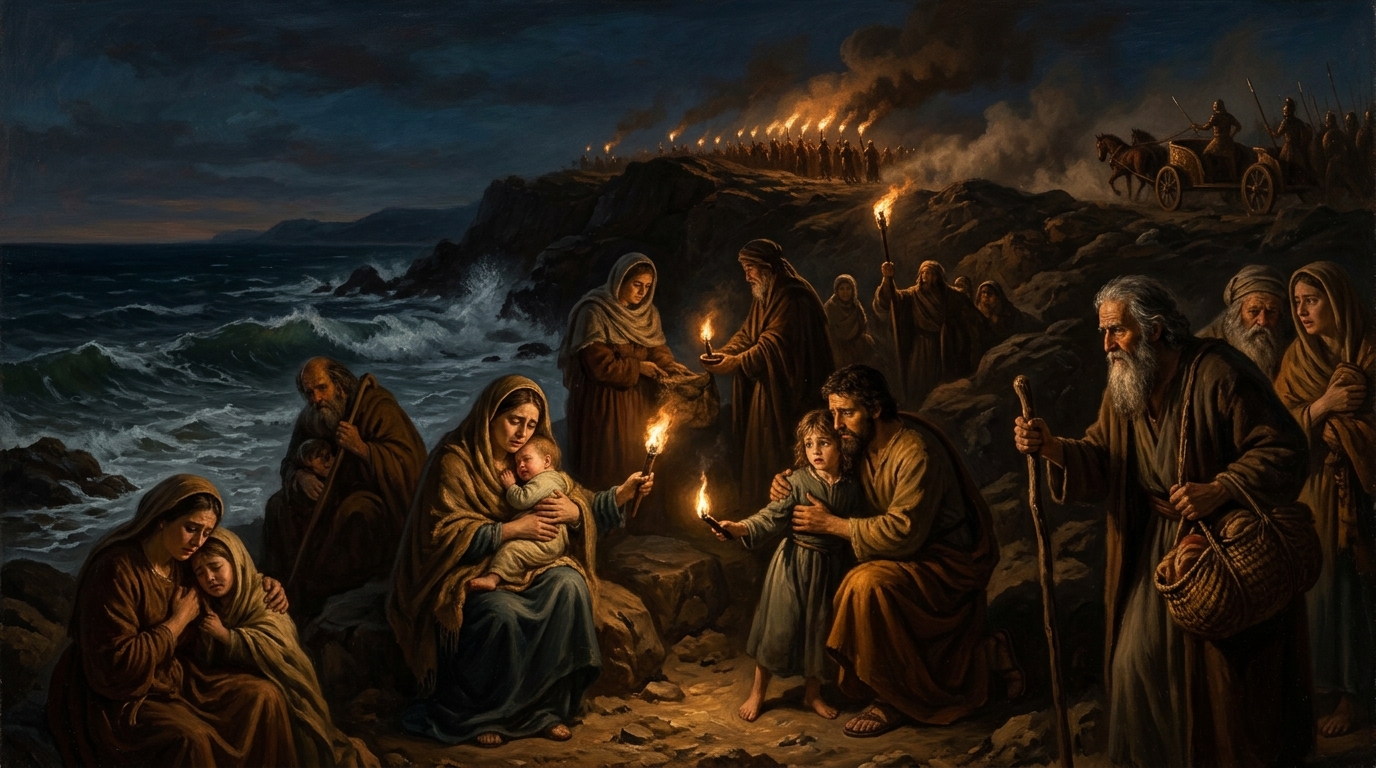
Panic instantly split open the deepest wound of the enslaved soul. Four hundred and thirty years beneath the taskmaster’s whip had taught them to prefer the familiar safety of an iron cage over the terrifying cost of freedom. Hundreds of frantic men surged around their eighty-year-old leader. Jabbing their fingers toward Moses’ face, they spat words bitter as gall: “Perhaps there were no graves in Egypt, therefore thou hast brought us to die in the wilderness: why wouldst thou do this, to lead us out of Egypt?”
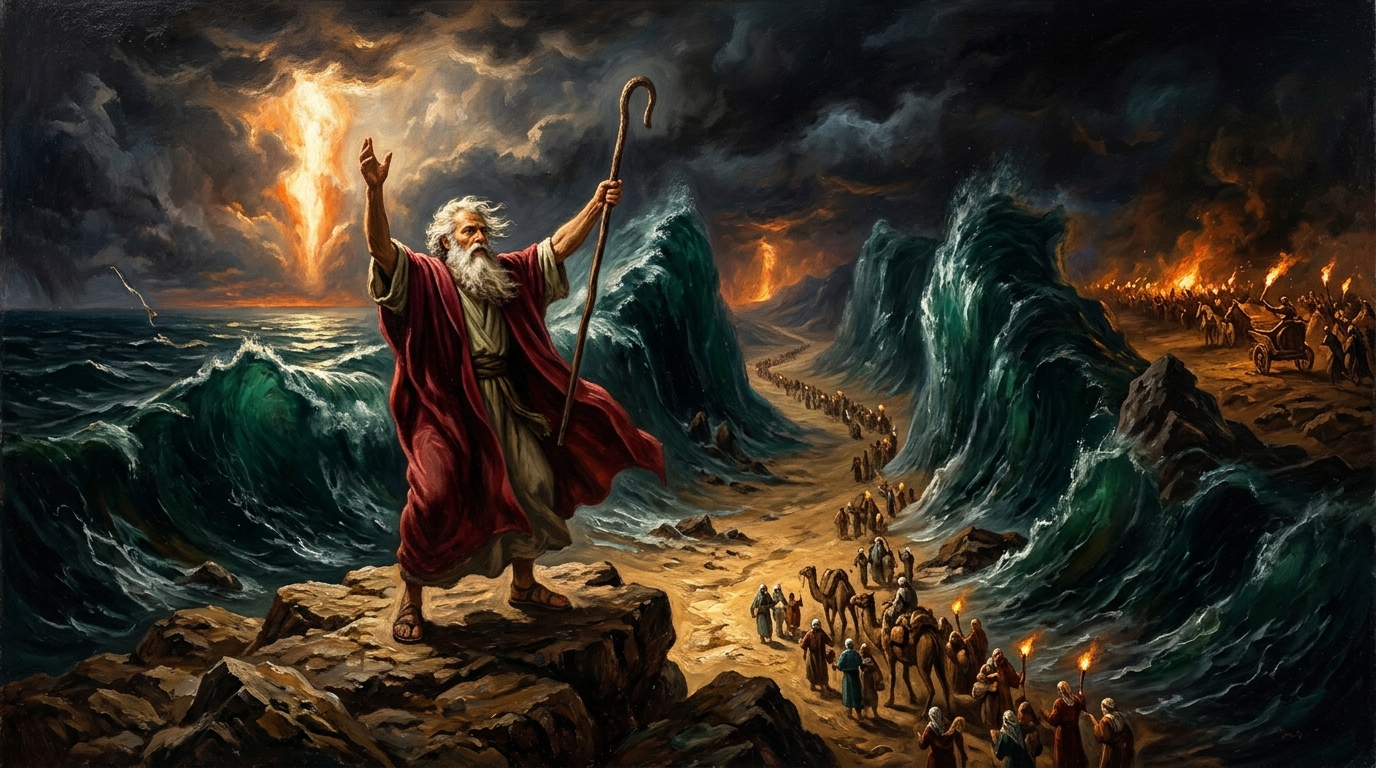
Shouting over the roar of the surf, the desperate crowd hurled back the very words they had spoken beside the brick pits of the Nile: “It had been better for us to serve the Egyptians, than to die in the wilderness!” Surrounded by the roar of a nation begging to surrender and the rumble of Pharaoh’s bronze wheels only hundreds of yards away, Moses stood alone upon a limestone outcrop at the water’s edge. The night gale whipped his white beard and coarse wool mantle.
Moses’ weathered hands closed tightly around his shepherd’s staff. It was nothing more than a sun-cracked branch of desert acacia, dried by forty solitary years in the wilderness of Midian—the rod with which he had tended the flock of his father-in-law Jethro, and the very staff God had commanded him to carry from the burning bush on Mount Horeb. Against six hundred armored chariots of the world’s mightiest superpower, Moses held no shield and no sword—only that dry piece of wood and the promise of I AM WHO AM.
The Dry Wooden Staff of Midian Against Six Hundred Armored Chariots
Moses did not flinch before the mutiny of the crowd. Nor did he turn to parley with Pharaoh’s captains. Amid a pandemonium no human general could have restrained, he squared his shoulders upon the seaside rock, lifted his wooden staff against the black sky, and raised his voice with a prophetic authority that cut straight through the crashing waves and the weeping of the tribes.
Every syllable nailed itself into the night of Pi-hahiroth: “Fear not: stand, and see the great wonders of the Lord, which he will do this day; for the Egyptians, whom you see now, you shall see no more for ever.”
The Immortal Command in the Dead End: Fear Not, Stand Still!
To mortal calculation, that promise sounded like madness. How could they never again see an army whose spearpoints were already gleaming a bowshot away? How could six hundred thousand people escape when behind them lay only the black abyss of the sea without a single ship? Yet the very instant Moses’ voice fell silent, watchmen along the rear perimeter pointed skyward with a gasp of awe: the towering pillar of cloud that had led them across the desert was suddenly moving through the darkness.
“And Moses said to the people: Fear not: stand, and see the great wonders of the Lord, which he will do this day; for the Egyptians, whom you see now, you shall see no more for ever.”— The Book of Exodus 14:13
Almighty and ever-living God, You led Your people into the midnight cul-de-sac of Pi-hahiroth not to abandon them, but to reveal Your glory. Forgive us for the many times when illness, financial pressure, or family crisis closes in around us and our hearts murmur in fear like Israel by the sea. Engrave deep within our souls the fearless command of Moses: 'Fear not: stand!' Grant us the grace to stand firm in faith until we behold Your salvation. Through Christ our Lord. Amen.
Biblical & Historical Questions Answered
Where were Pi-hahiroth, Migdol, and Beelzephon located in Exodus 14?
Why did God command Moses to turn back and camp by the sea instead of taking the direct coastal road?
How formidable were Pharaoh’s six hundred chosen chariots in the ancient world?
Carry This Story Into Silent Prayer
Light a free 24-hour vigil candle for someone you love or rest in the candlelit 3D Chapel.