September Morning in the Wooden Choir Loft and the Wounds No Doctor Could Close
On a quiet autumn morning in 1918 in the wooden choir loft of Our Lady of Grace friary, a thirty-one-year-old Capuchin priest collapses onto the pine floorboards with his hands pierced through and bleeding arterial blood scented with violets—beginning fifty years marked by the Cross and relentless medical scrutiny.
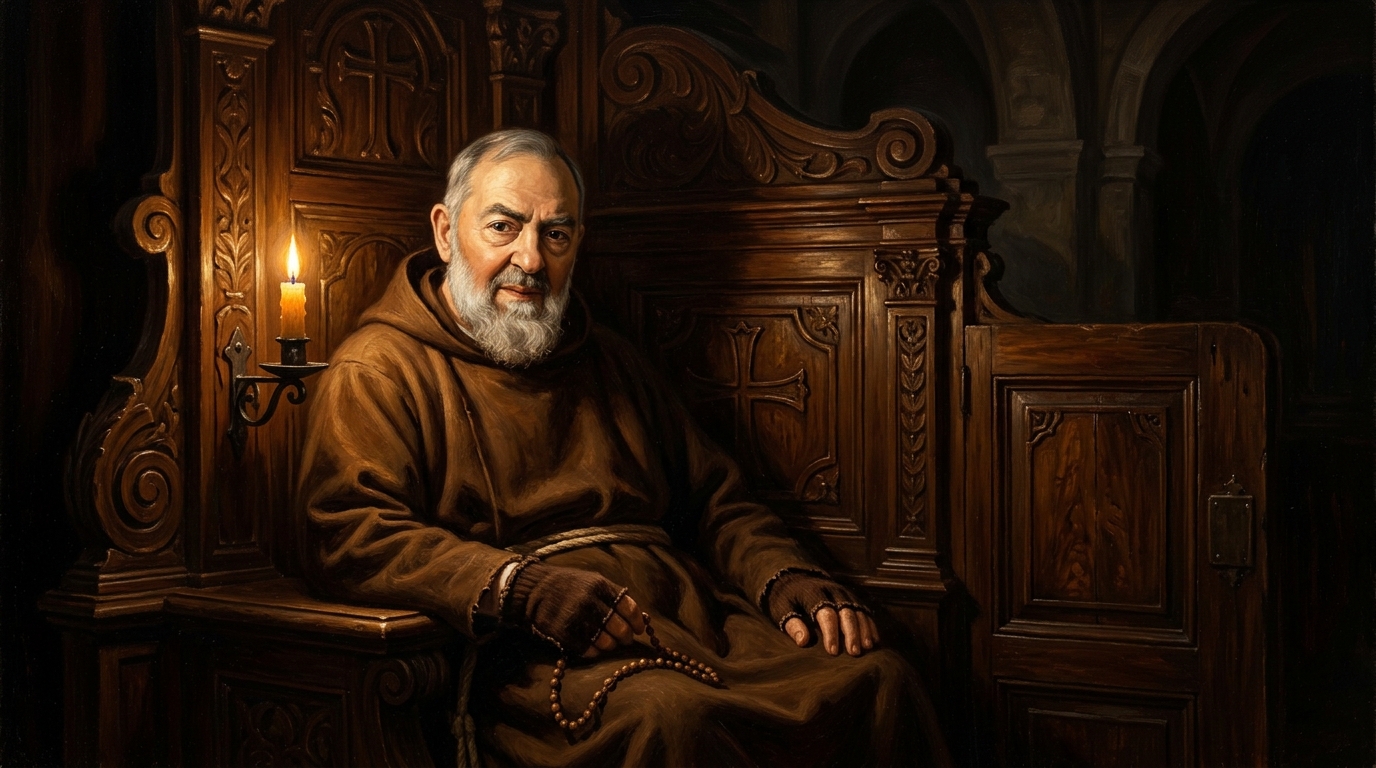 SCENT OF VIOLETS
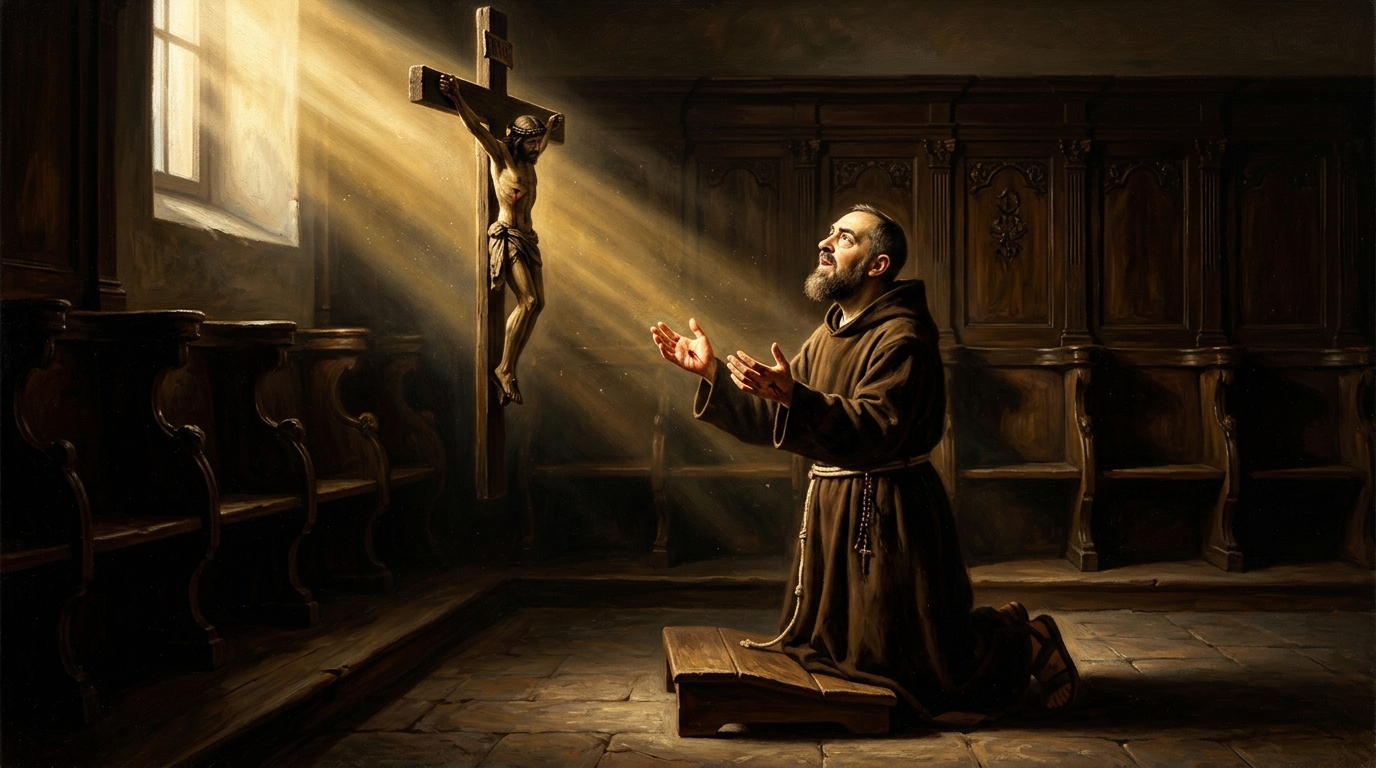
Thick drops of crimson blood pattered onto the dry pine floorboards in the stillness heavy with beeswax and old incense. On the morning of Friday, September 20, 1918, the little church of Our Lady of Grace perched high on the limestone slopes of Mount Gargano stood completely empty. Outside those stone walls, the Spanish flu pandemic and the final trenches of the First World War were turning Europe into a vast graveyard. Up in the narrow wooden choir loft behind the high altar, thirty-one-year-old Capuchin friar Francesco Forgione—whom the mountain peasants called simply Padre Pio—knelt alone making his thanksgiving after Mass before a dark cypress Crucifix.
There was no thunderclap in the sky. Only a sudden, crushing stillness that pressed against his ribs as though all the air on the mountain had stopped moving. In the blazing vision he was later compelled under vow of obedience to describe in writing to his spiritual director, a mysterious Personage with hands, feet, and side streaming with blood stood before him. Shafts of fire sharp as steel lances pierced the palms, feet, and left side of the young priest. Padre Pio collapsed onto the wooden planking. When he regained consciousness amid searing agony, the centers of both hands were pierced straight through, and bright blood was soaking the coarse sleeves of his brown Capuchin habit.
The Secret of Cell Number Five and the Brown Wool Half-Gloves
Bracing his elbows against the whitewashed wall of the narrow corridor, the young friar dragged himself to Cell Number 5, trying to hide his bleeding hands inside the folds of his wool habit. He wanted no one on earth to see them. To Francesco—the peasant boy born in 1887 among the stone alleys of Pietrelcina, whose father Grazio had twice crossed the Atlantic to America to labor with a pickaxe so his son could study for the priesthood—those wounds were not badges of spiritual prestige. They were a terrifying secret between his soul and the Crucified, a victim offering of reparation he had quietly begged to carry for a world drowning in the blood of war and for the souls in purgatory.
To conceal the wounds from his fellow friars and the villagers, Padre Pio slipped on a pair of coarse brown wool half-gloves that covered his palms and the backs of his hands, leaving only his fingers free to hold the Sacred Host. Yet how can a priest hide fresh arterial blood flowing every single day from five open wounds that never scabbed over? Within weeks, the bloodied linen corporals on the altar and an inexplicable phenomenon—a pure, unmistakable fragrance of wild violets and fresh roses rising directly from the blood-soaked bandages—sent word racing through the valleys of southern Italy like fire through dry brush.
Thousands of farmers, crippled veterans, and bereaved mothers began climbing the rocky mule tracks of San Giovanni Rotondo in search of the stigmatized friar. And alongside the weeping crowds begging for healing, cold, skeptical eyes from Rome and from the medical faculties of Italy turned immediately toward Cell Number 5. The twentieth century of scientific positivism had no patience for medieval legends; it demanded magnifying lenses, chemical reagents, wax-sealed bandages, and forensic transcripts.
When Medical Lenses and Wax Seals Confronted the Five Wounds
In May 1919, Dr. Luigi Romanelli, chief physician of the civil hospital of Barletta, was dispatched to conduct the first official examination. He peeled the brown wool half-gloves stiff with dried blood from Padre Pio’s hands. Beneath the bright lamp, the physician froze: the lesion was no surface scratch, but a deep perforation passing straight through the hand. When Dr. Romanelli pressed his fingers simultaneously against the palm and the back of Padre Pio’s hand, he felt his own fingertips nearly meet in the middle through a paper-thin membrane of living tissue, while the young priest bit his lip in silence.
Two months later, Professor Amico Bignami—chair of pathology at the University of Rome and an outspoken agnostic—climbed Mount Gargano suspecting that the friar was consciously or unconsciously keeping the wounds open with tincture of iodine or carbolic acid. To settle the question beyond doubt, Bignami ordered Padre Pio’s hands bound in thick bandages and sealed with stamped wax before witnesses for eight consecutive days and nights, banning all antiseptics from the cell. On the eighth day, when the wax seals were broken and the gauze unwound, the pathologist stood speechless: with zero chemical agents present, fresh arterial blood was still welling up without a single drop of pus, without swelling, and without necrosis—defying every known law of wound pathology.
Shortly thereafter, surgeon Dr. Giorgio Festa conducted three independent clinical inspections in 1919, 1920, and 1925. His official medical report documented that in addition to the hands and feet, Padre Pio bore on the left side of his chest a cross-shaped laceration seven centimeters long that bled pure blood continuously. More astonishing still, the blood from those wounds gave off such an intense fragrance of violets that when Dr. Festa sealed a blood-stained cloth inside his leather medical bag to bring back to Rome for laboratory analysis, the entire railway compartment filled with the scent of fresh violets throughout the journey.
The Prayer to Hide the Shame and the Mass Upon Calvary
One might imagine that once medical science had ruled out fraud, Padre Pio would be placed upon a pedestal. The exact opposite happened. For the friar himself, being forced to uncover his chest and hands before dozens of physicians and inquisitors who probed his open wounds with forceps under glaring lamps was a moral crucifixion more humiliating than the pain of the nails. Many nights in the biting winter cold of Mount Gargano, he stared at the brown wool gloves lying beside his Crucifix and wept aloud: “My Jesus, take away this confusion and outward shame! Leave me only the hidden pain in my heart, and hide these marks from the eyes of men!”
Yet his plea that the visible marks be removed was not granted. All five wounds remained open each dawn as he climbed the altar steps. Those who attended his early morning Mass never forgot the moment of the Elevation: as Padre Pio raised the consecrated Host and Chalice high above the altar, the wide sleeves of his alb slipped back slightly, exposing the bandaged, blood-stained wrists trembling beneath the weight of the sacrifice—making visible to every eye that this priest was not merely reciting the words of Calvary, but standing nailed upon it.
The Scent of Violets in Fresh Blood and the Gathering Storm
Those fingerless brown wool gloves became the inseparable sign of the humble son of Pietrelcina. He wore them as he fingered his Rosary beads, as he laid his hand upon the heads of crippled children, and as he sat inside the oak confessional for fifteen hours a day. Yet the wider the crowds gathered around the mountain friary, the darker grew a storm of ecclesiastical jealousy, local political greed, and slanderous dossiers behind the scenes—preparing the decree that would lock Padre Pio behind the sacristy doors for ten long winters.
“From henceforth let no man be troublesome to me: for I bear the marks of the Lord Jesus in my body.”— The Letter to the Galatians 6:17
Lord Jesus Crucified, You imprinted upon the flesh of Saint Padre Pio the five wounds of Your redeeming love in the humble wooden choir loft of Mount Gargano. Heal our hearts of the thirst for human praise and the cowardly flight from sacrifice. Whenever we are visited by bodily pain or interior wounds that no one around us understands, teach us to unite every drop of our suffering to Your Altar for the conversion of sinners and the comfort of the afflicted. Amen.
Biblical & Historical Questions Answered
When did Saint Padre Pio receive the stigmata, and how long did the wounds remain open?
What did the independent physicians who examined Padre Pio’s wounds conclude?
Why did the Catholic Church investigate Padre Pio’s stigmata with such strict caution?
Carry This Story Into Silent Prayer
Light a free 24-hour vigil candle for someone you love or rest in the candlelit 3D Chapel.