The Widow’s Gold Coin, the Four-O’Clock Confessional, and the Dawn the Gloves Came Off
From a single small gold coin tucked inside his habit pocket and his heartbreak over mountain peasants dying on mule carts for lack of a doctor, the priest who spent eighteen hours a day in the confessional raised a monumental white hospital upon barren limestone—before all five of his wounds vanished without a trace at the hour of his death.
 NOT ONE SCAR
At four o’clock in the morning high on Mount Gargano, white frost coated the freezing limestone steps outside the little church of Our Lady of Grace. While the rest of Italy still slept, thousands of pilgrims were already standing in line beneath flickering oil lanterns waiting for the heavy wooden doors to swing open. Inside, Padre Pio had been awake since half past two, his bandaged fingers moving across his Rosary beads as he prepared for a two-hour Mass followed by a grueling sixteen- to eighteen-hour day locked inside the cramped oak box of his confessional.
Padre Pio’s confessional was no parlor of soothing platitudes. It was an operating room for immortal souls. Gifted by God with the supernatural charism of reading hearts, the priest wearing blood-stained brown wool half-gloves regularly reminded penitents of grave sins they had concealed out of shame or forgotten twenty years earlier! At times he sent away with stern rebuke those who approached without genuine contrition, yet that fierce paternal love broke open the hardest hearts and brought them weeping back to grace. In 1947, a young Polish priest named Father Karol Wojtyła knelt beside that wooden grate—and more than half a century later, that same young priest, as Pope Saint John Paul II, would canonize Padre Pio before the entire world.
The Four-O’Clock Confessional and the Grief of Peasants Dying Without a Doctor
Yet Padre Pio never separated the salvation of souls from the relief of bodily suffering among the poor. Whenever he stepped outside the friary, his heart ached at the sight of Gargano mountain peasants stricken with tuberculosis, malaria, or childbirth hemorrhage being jolted for hours on wooden mule carts down forty kilometers of rocky mountain tracks toward the plains of Foggia in search of a doctor. Many died on the road before ever reaching a hospital bed.
On the night of January 9, 1940—just as Europe was plunging into the furnace of the Second World War and the village of San Giovanni Rotondo barely had running water—Padre Pio called three trusted friends into his cell: Dr. Carlo Kisvarday, Professor Mario Sanvico, and pharmacist Pietro Cugino. His dark eyes blazed beneath his thick brows: “Tonight our greatest earthly work begins: a great hospital built right upon this mountain rock, and its name shall be Casa Sollievo della Sofferenza—the Home for the Relief of Suffering!”
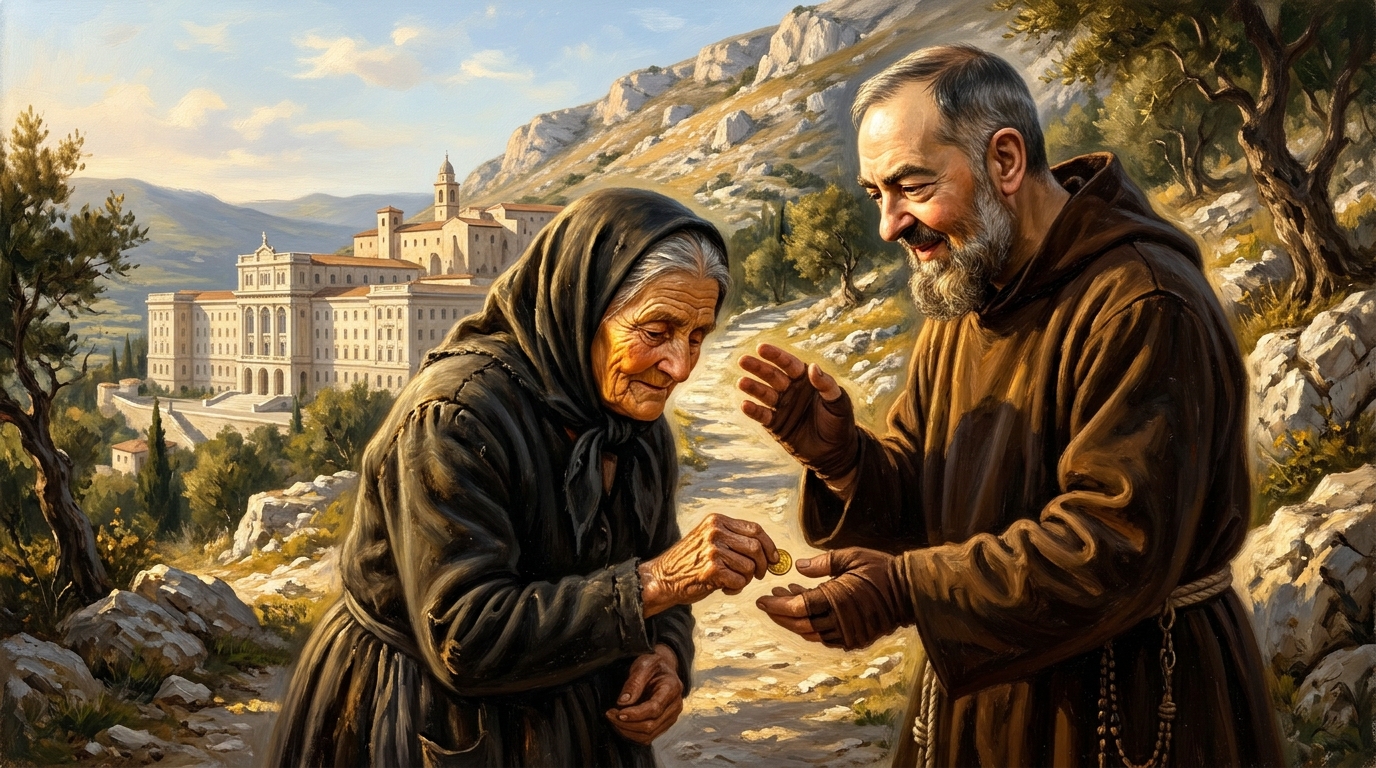
The three men stared at one another in disbelief. In the middle of a world war, upon a barren limestone crag without paved highways, where on earth would billions of lire come from to build a modern medical center? Without a word of theoretical debate, Padre Pio reached his wool-gloved hand deep into the pocket of his brown habit, drew out a single gleaming gold coin, and laid it upon the wooden table: “A poor widow just pressed this gold coin—the savings of her entire life—into my hand for our work of charity. I am officially the first donor!” Pointing to the sketches on the table, he declared that in every sick person lying upon a hospital bed, physicians must recognize and serve Jesus Christ Crucified.
The Widow’s Gold Coin and the Miracle of White Marble on the Rock
That prophetic gesture stirred the conscience of five continents. When pickaxes and dynamite began blasting into the solid limestone of Mount Gargano in 1947, the humble savings of coal miners, farmers, and widows across the globe—joined by a massive international grant from UNRRA championed by British journalist Barbara Ward—streamed into San Giovanni Rotondo like rivers of providence. Padre Pio watched over every sack of cement and every slab of marble. He refused to build a dreary shelter for paupers: he demanded the most advanced operating theaters in Europe, sunlit corridors, and rooftop gardens, insisting that “in the poor is Jesus, and for Jesus only the finest is worthy!”
On May 5, 1956, the miracle of white stone stood gleaming against the sky of Mount Gargano. To the astonishment of international medical specialists, Casa Sollievo della Sofferenza opened its doors with hundreds of state-of-the-art beds. Standing upon the marble steps of the hospital, the aged friar—bent double by half a century of daily blood loss—delivered his spiritual testament to the doctors and nurses: “You have the mission of curing disease, but if you do not bring love to the sickbed, medicine will avail very little. Bring God to the sick: that will be worth more than any remedy!”
Over the next twelve years, while the hospital on the rock saved tens of thousands of lives each year and “Padre Pio Prayer Groups” multiplied across the globe, the physical strength of their spiritual father burned down like a beeswax candle reaching its socket. By September 1968, at eighty-one years of age, Padre Pio was confined to a wheelchair from fifty years of daily hemorrhage and chronic bronchitis, yet he still insisted on rising before dawn to offer Mass and hear confessions.
Fifty Thousand Red Roses and the Final Mass of the Martyr of the Confessional
On September 20, 1968—the exact fiftieth anniversary of the morning he had received the stigmata in the wooden choir loft—the sanctuary of Our Lady of Grace was banked with fifty thousand crimson roses sent by his spiritual children from every nation. Two days later, on Sunday morning, September 22, 1968, summoning his last breath of strength, Padre Pio celebrated the solemn five-o’clock Mass before a vast sea of pilgrims. His voice trembled like a reed as he whispered the words of consecration, and as he imparted the final blessing, he collapsed into the arms of his brother friars.
That night, in the spare simplicity of his cell, Dr. Giuseppe Sala and the Capuchin friars kept vigil beside his bed. Padre Pio glanced repeatedly at the clock, asked to make his sacramental confession one last time, renewed his Franciscan vows, and gripped his Rosary beads between his fingers. His pale lips murmured without ceasing the two names that had carried him through eighty-one years of life: “Gesù... Maria... Jesus... Mary...” At 2:30 in the morning on September 23, 1968, the priest of the Altar and the Confessional quietly breathed his last.
Dawn on September 23: When the Brown Wool Gloves Came Off for the Last Time
And at the exact moment the friars and Dr. Giuseppe Sala leaned over to slip off the fingerless brown wool half-gloves and unwind the bandages from Padre Pio’s hands, feet, and side to prepare his body for burial, every man in the room froze in awe. The five deep wounds that had bled fresh arterial blood every single day for eighteen thousand two hundred and fifty days had vanished completely! Not a trace of dried blood remained, no perforation, and—most astonishing of all—not even the faintest white scar! The skin of the hands, feet, and chest of the eighty-one-year-old priest had become whole, pearly white, and as smooth as the skin of a newborn child—fulfilling to the letter the prophecy spoken fifty years earlier: once his victim mission upon Calvary was finished, the Crucified Lord had reclaimed His wounds to clothe His faithful servant in the dawn of the Resurrection.
“And the king answering, shall say to them: Amen, I say to you: as long as you did it to one of these, my least brethren, you did it to me.”— The Gospel according to Saint Matthew 25:40
Lord Jesus Christ, You taught us that every act of love done for the least of our brothers and sisters is done to You Yourself. We praise You for the radiant witness of Saint Padre Pio, who bound together the Altar of the Eucharist, the Confessional of Mercy, and the Sickbed of the Poor into a single sanctuary of charity. May the intercession of Saint Padre Pio uphold all physicians and nurses today, comfort the sick through their longest nights of pain, and teach us to live his timeless motto: Pray, Hope, and Don’t Worry. Amen.
Biblical & Historical Questions Answered
How does Padre Pio’s hospital, Casa Sollievo della Sofferenza, operate today?
Is it true that Padre Pio’s five wounds disappeared completely without leaving scars when he died?
When was Saint Padre Pio canonized, and when is his feast day celebrated?
Carry This Story Into Silent Prayer
Light a free 24-hour vigil candle for someone you love or rest in the candlelit 3D Chapel.