The Freezing Stone Cloister of Lisieux and the Smile Hidden Behind a Wool Habit
Stepping through the iron enclosure door of the Lisieux Carmel at fifteen years of age, the pampered youngest daughter of watchmaker Louis Martin confronts the bone-chilling winters of Normandy, dirty washwater splashed across her face, and the unseen thorns of common life—quietly tucking dried rose petals beside the small wooden Crucifix in her habit pocket.
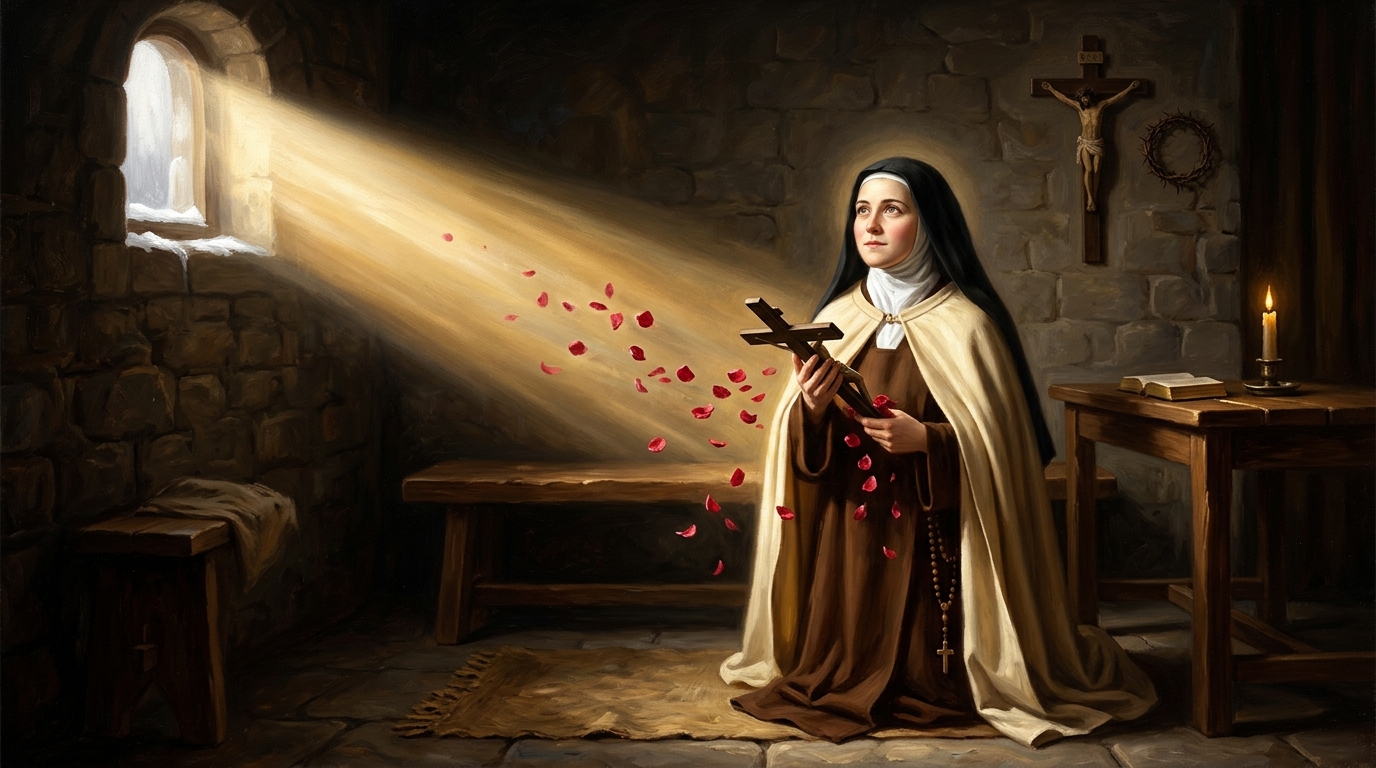 PETALS ON THE CROSS
Every breath turned to white frost against her coarse black veil as the five-o’clock bronze bell finished ringing down the stone corridor of the Lisieux Carmel. The Normandy winter of 1889 in northern France was so bitter that the water inside the earthenware pitcher standing in the corner of her cell froze into solid ice overnight. Inside unheated Cell Number 26, sixteen-year-old Thérèse Martin—now known in religion as Sister Thérèse of the Child Jesus and the Holy Face—slipped feet swollen with chilblains into rough hemp sandals and stepped quietly out into the damp cloister without breathing a single sigh of complaint.
Few people outside those thirteen-foot enclosure walls could have imagined so stark a transition. Barely a year earlier, inside the warm family home of Les Buissonnets shaded by chestnut trees, Thérèse had still been the “Little Queen” cherished by her saintly father, master watchmaker and jeweler Louis Martin, after her mother Zélie Guérin died of breast cancer when the girl was four and a half. To win permission to enter the cloister at fifteen after local church authorities refused on account of her youth, that iron-willed teenager had ridden a train across the Alps to Rome with her father in November 1887 and, breaking papal protocol, flung her arms weeping around the knees of Pope Leo XIII until two Noble Guards lifted her to her feet.
From Little Queen of the Martin Household to the Strict Discipline of the Cloister
Yet when the heavy iron door of the Lisieux Carmel bolted shut behind her on the morning of April 9, 1888, God did not greet her with sweet visions or consolations. He met her with the bare dryness of desert sand. The prioress of the monastery at the time, Mother Marie de Gonzague—knowing full well how tenderly the youngest Martin daughter had been doted upon by her father and four older sisters—resolved to temper the fifteen-year-old postulant in the strictest discipline: not a word of praise, public rebukes in chapter, and the humblest chores of sweeping staircases and weeding courtyard stones.
Deep inside the pocket of her heavy brown wool habit, Thérèse kept a tiny treasure as a private secret between her soul and her Divine Spouse: a small wooden Crucifix bearing a bronze corpus, around the base of which she quietly tucked dried red rose petals gathered from the cloister garden. To many nineteenth-century nuns steeped in an austere spirituality that measured holiness by extraordinary fasts, iron discipline chains, and prolonged ecstasies, this round-faced young novice looked altogether ordinary—even slightly clumsy at manual housework.
Some of the older sisters even whispered among themselves during sewing recreation: “Little Sister Thérèse is sweet enough, to be sure, but she does nothing extraordinary; if she dies young, Mother Prioress will hardly find three lines to write in her obituary circular!” They had no inkling that right in the middle of those unremarkable daily chores no one noticed, the teenager was waging an interior spiritual revolution fiercer than a general’s campaign.
The Revolution at the Stone Washtub and Dirty Water Turned into Pearls
In the communal washhouse thick with cold lye steam on winter afternoons, the sister standing directly across the stone tub from Thérèse had a habit of scrubbing wet handkerchiefs violently against her wooden board, sending splashes of dirty soapy water straight into Thérèse’s forehead and cheeks with every stroke. Hot blood rushed to the cheeks of a girl who by nature was intensely sensitive; her first instinct urged her to step back and wipe her face pointedly with her sleeve so the sister would stop. Yet the instant her fingers brushed the small wooden Crucifix inside her pocket, Thérèse thought to herself: “If Jesus is tossing these drops of dirty water to me like pearls to save souls, why should I refuse His gift?” For the entire hour at the washtub she stood still with a bright smile, welcoming the dirty splashes across her face as though they were rosewater.
Up in the chapel choir during evening mental prayer, a sister kneeling directly behind Thérèse had a nervous tic of making an incessant, grating noise—like two seashells rubbing together or fingernails clicking—in the dead stillness. That tiny, repetitive scraping drilled into Thérèse’s eardrums until cold sweat broke out on her brow from headache and she ached to turn her head and glare. Instead of turning around, Thérèse closed her eyes and offered that nerve-racking sound to God as a symphony of music for the conversion of sinners and the strength of some exhausted missionary priest at the ends of the earth.
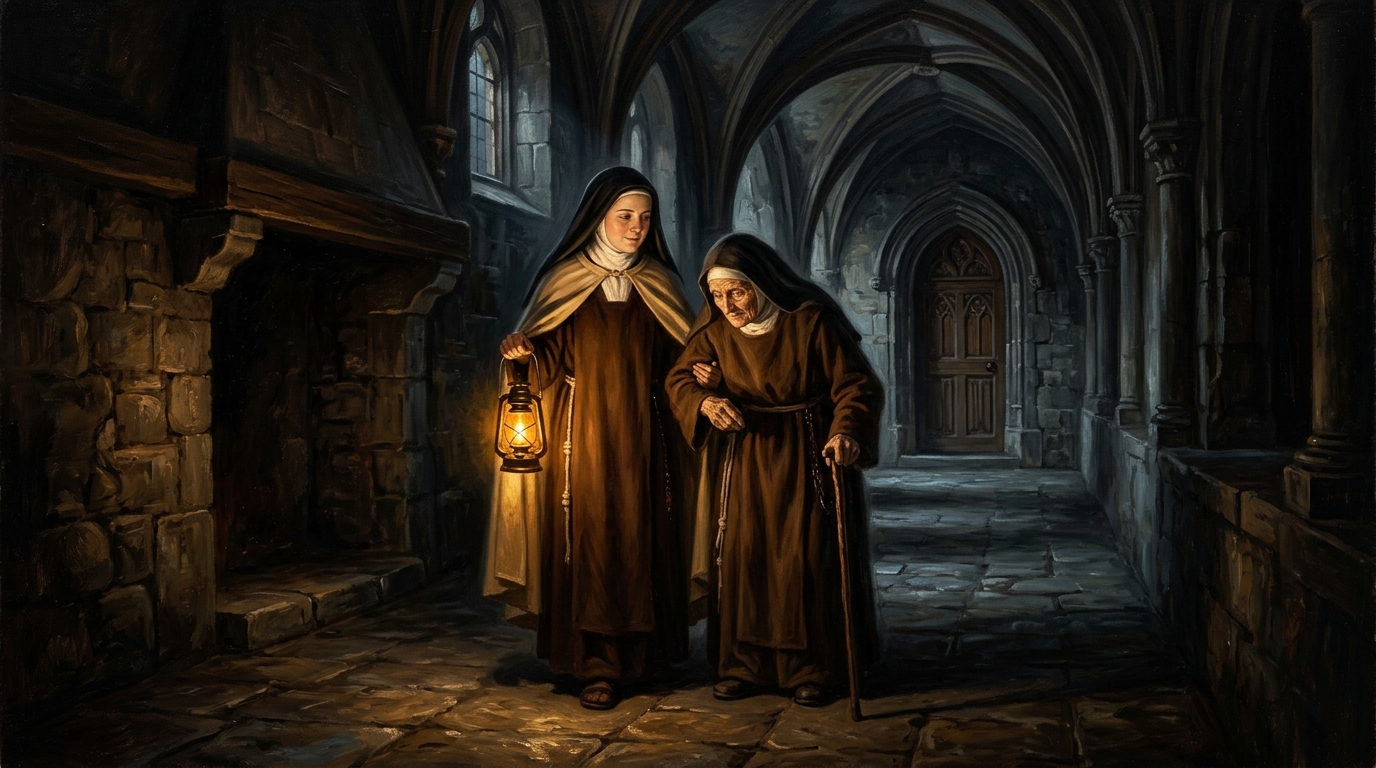
More demanding still was her daily service to Sister Saint Peter—an elderly nun crippled by deforming rheumatism and so frayed in nerves that she snapped at everyone around her. Every afternoon at a quarter to six, when other sisters quietly slipped out of sight, Thérèse stepped forward with a gentle bow to support the old woman from choir to the refectory. Walking inch by inch at the invalid’s shuffling pace, she was scolded the entire way: one moment blamed for walking too fast and making her stumble, the next scolded for walking too slowly and tiring her back, before having to cut the old nun’s bread into exact tiny squares at table. And the parting gift Thérèse gave that cranky sister every single evening was the most radiant smile she could summon.
A Smile for the Cantankerous Elder Nun and the Cross of Her Father’s Illness
Deeper by far than all the pinpricks of community life was the blow that struck her family in 1889: her beloved father Louis Martin—the “King” of her childhood—suffered severe cerebral strokes that clouded his mind and required his confinement for three long years inside the Bon Sauveur psychiatric asylum in Caen. Through the streets of Lisieux, cruel tongues gossiped that the old watchmaker had gone mad with grief because his daughters had abandoned him for the convent. That public humiliation crushed the sixteen-year-old novice’s heart like a millstone grinding wheat.
On the day of her Clothing in the habit (January 10, 1889) and later at her Profession of Vows (September 8, 1890), while her stricken father was absent, a sudden snowfall blanketed the monastery courtyard in dazzling white to the sound of the organ. Thérèse understood that the Child Jesus had chosen to clothe her in the bridal gown of trial and utter littleness.Pinned over her heart beneath her habit, she wore her profession letter inscribed with a prayer of breathtaking audacity: “O Jesus, my Divine Spouse, grant that I may die a martyr of Your love, and permit no creature on earth to know my suffering, save You alone!”
Dried Rose Petals on the Wooden Crucifix and the Midnight Cough
Night after night, when the entire Carmel lay asleep, the young nun lay awake in the biting cold of Cell Number 26, her fingertips resting silently against the dried rose petals tucked beside her small wooden Crucifix. Her heart burned with the desire to be priest, apostle, warrior, and missionary across all five continents until the end of time—yet before her eyes stood only four silent stone walls and a dry, deep cough beginning to rise from the bottom of her lungs at midnight.
“And said: Amen I say unto you, *unless you be converted, and become as little children, you shall not enter into the kingdom of heaven.”— The Gospel according to Saint Matthew 18:3
Lord Jesus, You declared that unless we turn and become like little children we shall not enter the Kingdom of Heaven. Through the luminous example of Saint Thérèse along the freezing stone corridors of Lisieux, heal our touchy pride and our craving for human applause. Teach us to gather every tiny sacrifice and every silent act of patience in our home like rose petals laid at the foot of Your Cross. Amen.
Biblical & Historical Questions Answered
What was Saint Thérèse of Lisieux’s family background before she entered the convent?
How did Thérèse Martin manage to enter the Carmelite cloister at age 15 when the rule required age 21?
What were the concrete “little sacrifices” Saint Thérèse practiced in secret inside the monastery?
Carry This Story Into Silent Prayer
Light a free 24-hour vigil candle for someone you love or rest in the candlelit 3D Chapel.