The Promise from an Infirmary Bed at 24: “I Will Spend My Heaven Doing Good Upon Earth”
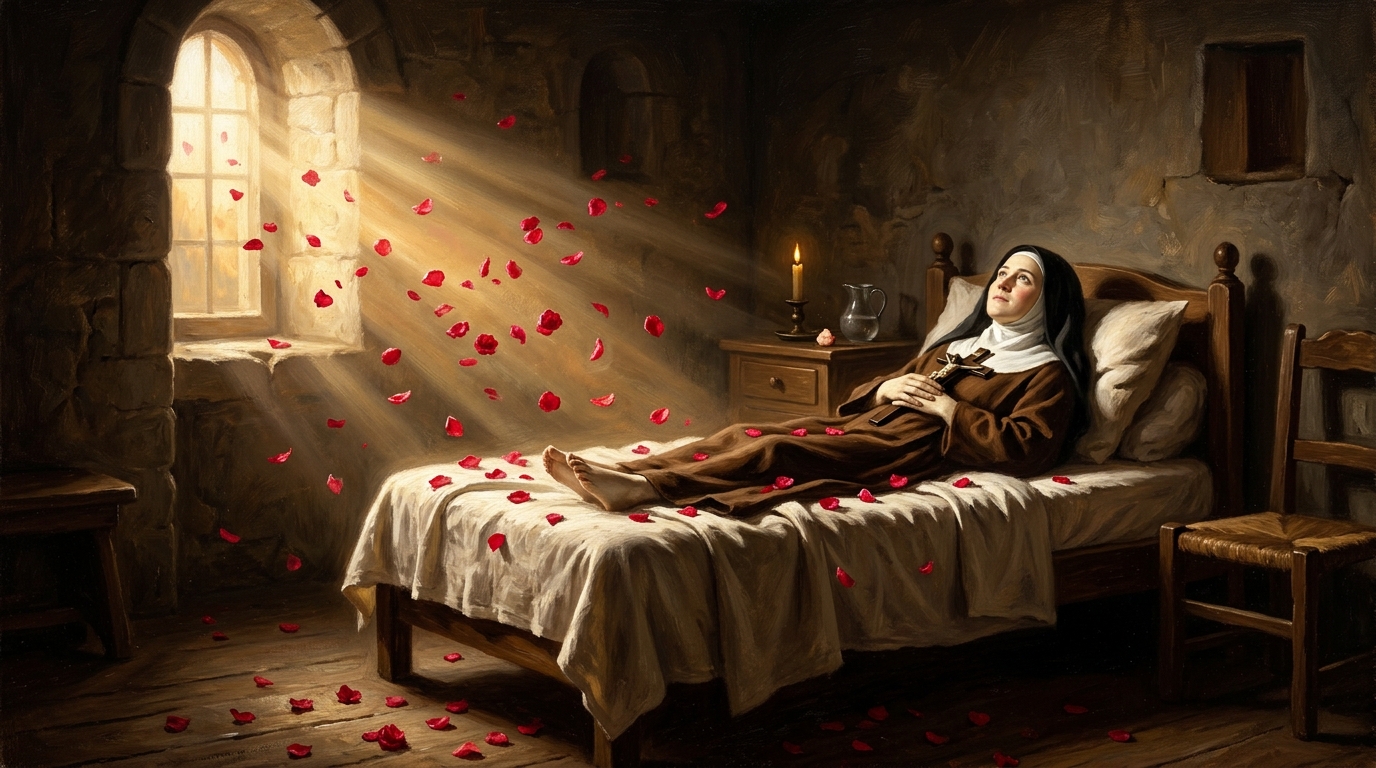
In the summer of 1897, behind the brown serge curtains of an iron infirmary bed in the Lisieux Carmel, with both lungs destroyed by tuberculosis, the twenty-four-year-old nun plucks red rose petals over her wooden Crucifix and leaves the promise that would echo across centuries: “After my death, I will let fall a shower of roses!”
 SPEND MY HEAVEN
Short, rasping breaths sounded from behind the brown serge curtains of the iron bedstead pushed beside the infirmary window of the Lisieux Carmel in July 1897. At twenty-four years of age, the body of Sister Thérèse of the Child Jesus had wasted to a fragile frame of bones consumed by hundred-and-four-degree fevers and hemorrhages lasting for hours. Tuberculosis had spread to her intestines, making it impossible to keep down anything beyond tiny sips of milk, while her back, immobilized for months on a hard straw mattress, had broken open into raw bedsores without the relief of a single morphine injection.
And yet every sister who stepped across the threshold of the infirmary stopped in wonder. Not a single groan of impatience came from that bed. Against the white pillow, the hollowed face of the twenty-four-year-old nun still wore a clear, childlike smile, while her pale fingers clasped without ceasing the small wooden Crucifix that had ridden inside her habit pocket for nine years. Every afternoon, the sisters gathered fresh crimson roses from the cloister garden and brought them to her bedside.
Red Rose Petals Scattered Over the Wooden Crucifix on a Bed of Pain at Twenty-Four
Propped against her pillows, Thérèse lifted each rose in her trembling fingers, slowly plucked its deep red petals one by one, and scattered them across the bronze corpus of Jesus Crucified nailed to her wooden Cross, caressing each wound of Our Lord with a fragrant petal. When the petals slid down her wool blanket and fell onto the cold floor tiles beside the bed, the sisters bent down to sweep them away. But Thérèse stopped them with a luminous gaze that reached far beyond the monastery walls: “My sisters, gather up carefully every single petal that has touched the Crucifix of our Spouse, do not lose one... for later on they will serve to do good and bring graces to others!”
Sitting beside the bed with a small notebook and pencil in hand to record every word of her dying sister (the historical transcripts published as Last Conversations), Mother Agnès asked in a choked voice: “My darling little sister, when you are up in Heaven with the good God, will you look down upon us?” Thérèse shook her head with a bright smile: “No, Mother! I will not look down—I will come down! I cannot take my rest in Heaven so long as there remain souls on earth to be helped and saved!”
And then, in a voice barely above a whisper yet firm as an oath sworn before the throne of God, that twenty-four-year-old girl who had never traveled beyond her quiet Norman town spoke the sentence that would shake modern Church history: “I feel that my mission is about to begin... my mission of making the good God loved as I love Him, of teaching souls my little way of trust and self-surrender. If the good God grants my desires, my Heaven will be spent upon earth until the end of time! Yes, I want to spend my Heaven doing good upon earth! After my death, I will let fall a shower of roses!”
The Immortal Vow: “I Want to Spend My Heaven Doing Good Upon Earth!”
On Thursday afternoon, September 30, 1897, her final agony stretched across long hours of suffocating struggle. Cold sweat plastered her cropped hair to her forehead; every breath drawn in felt like iron blades tearing her chest. At the height of that bodily martyrdom, her fingers never once let go of the wooden Crucifix covered with red rose petals. At precisely twenty minutes past seven in the evening, before the entire community kneeling around her bed, Thérèse looked down at her Crucifix and then suddenly raised her deep blue eyes upward in a luminous ecstasy that transfigured her face, whispering her last words on earth: “Oh!... I love Him!... My God... I love You!”—and gently bowed her head, breathing her last.
The burial of the young Carmelite on October 4, 1897, in the municipal cemetery of Lisieux drew fewer than thirty relatives and neighbors under a chill autumn drizzle. Not a single newspaper in France printed a line. Yet exactly one year later, when Mother Agnès had two thousand copies of Story of a Soul printed from Thérèse’s three school exercise books to mail as the customary obituary circular to other Carmelite convents, an unprecedented “hurricane of glory and grace” broke across the Catholic world.
Those first two thousand copies sold out within months; tens of thousands followed, then millions of volumes translated into more than fifty languages. More astonishing even than the printed pages was the literal fulfillment of her “rain of roses” promise: in the muddy trenches of the First World War, inside African leper colonies, and across missionary outposts in China, Vietnam, Brazil, Latin America, and the Arctic, thousands of soldiers, dying patients, and missionaries suddenly smelled an inexplicable fragrance of fresh roses or received a red rose in their hands at the exact moment their prayers were answered.
From a Funeral of Thirty Mourners to a Hurricane of Roses Across Five Continents
Barely twenty-eight years after her death—setting aside the fifty-year canonical waiting period required at the time—on May 17, 1925, before half a million pilgrims packing Saint Peter’s Basilica lit by tens of thousands of oil lamps, Pope Pius XI solemnly canonized Saint Thérèse of the Child Jesus, calling her “the Star of my pontificate.”
And the greatest paradox in ecclesiastical history was sealed on December 14, 1927: Pope Pius XI signed the decree proclaiming Saint Thérèse of Lisieux—a young woman who had never set foot outside the grilles of her monastery during nine years of religious life—Universal Patroness of Missions throughout the world, equal in title to Saint Francis Xavier, the giant who had sailed to India and Japan! Seventy years later, on October 19, 1997, Saint John Paul II crowned the twenty-four-year-old nun once more by proclaiming her a Doctor of the Universal Church in the “Science of Divine Love.”
God’s Paradox: The Cloistered Nun Crowned Patroness of Missions and Doctor of the Church
Those tiny dried rose petals that the fifteen-year-old postulant had secretly tucked beside her wooden Crucifix along the freezing stone corridors of Lisieux did not rot in the dust of the grave. They multiplied into an unending rain of red roses that has kept falling for more than a century across all five continents—proving forever that before the eyes of God, a single tear offered in silence or a hidden prayer whispered in a dark room out of pure love holds the same redeeming power as the greatest apostolic expeditions on earth.
“*And hope confoundeth not: because the charity of God is poured out into our hearts, by the Holy Ghost, who is given to us.”— The Letter of Saint Paul to the Romans 5:5
God of infinite Love, You poured forth Your charity into the heart of Saint Thérèse of the Child Jesus and made a cloistered Carmelite nun who died at twenty-four the Universal Patroness of Missions. Teach us to do the small things of every day with immense love. Through the intercession of Saint Thérèse, let fall today upon our family and upon every sorrowing heart a rose petal of hope and consolation. Amen.
Biblical & Historical Questions Answered
Why was Saint Thérèse of Lisieux proclaimed Patroness of World Missions when she never left her convent?
Where did the tradition of the “Novena of Roses” to Saint Thérèse originate?
When was Saint Thérèse of Lisieux proclaimed a Doctor of the Church?
Carry This Story Into Silent Prayer
Light a free 24-hour vigil candle for someone you love or rest in the candlelit 3D Chapel.