After Carmel’s Fire: When the Victorious Prophet Fled Terrified into the Wilderness
With his sheepskin mantle still reeking of scorched limestone from Mount Carmel and his bare feet bleeding after outrunning King Ahab’s chariot in the storm, Elijah shatters at midnight under a single death oath from Queen Jezebel.
 ROYAL DEATH WARRANT
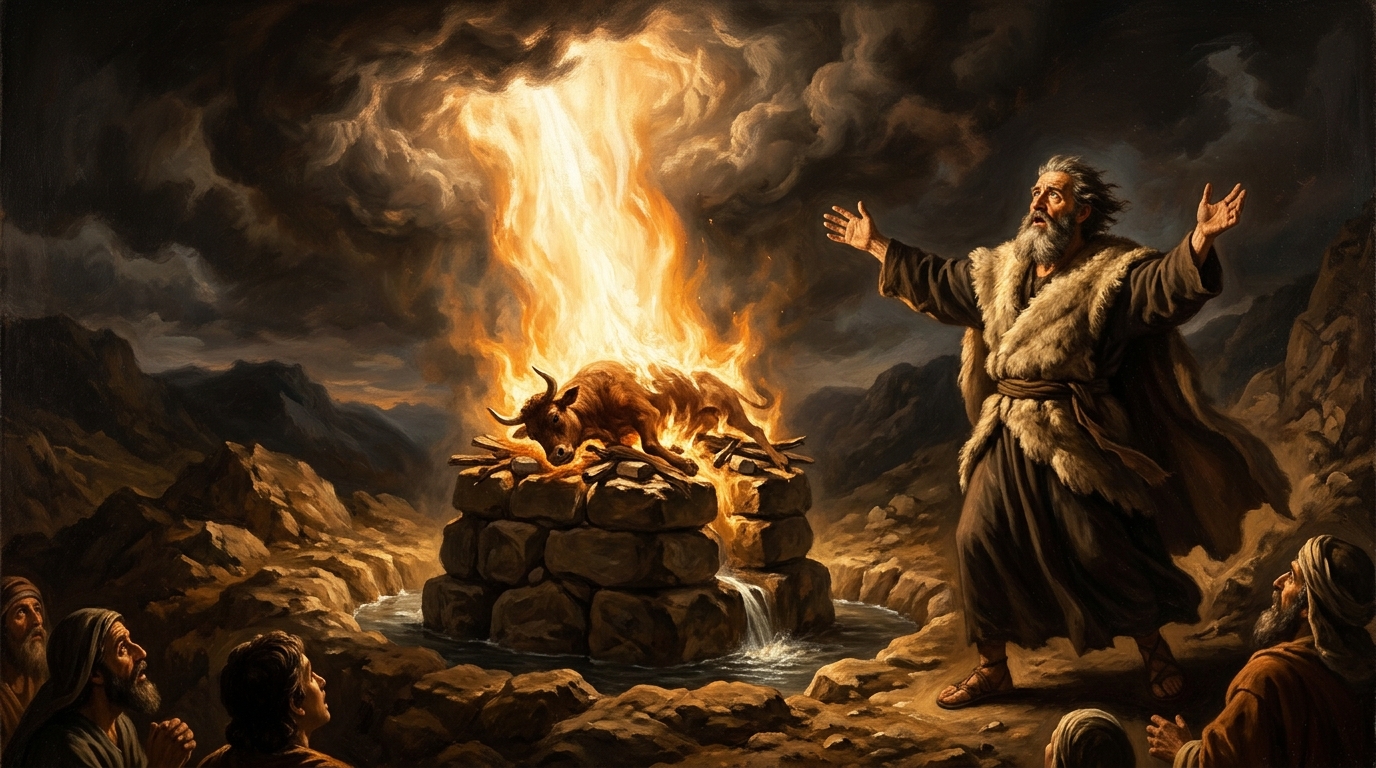
Acrid fumes of fused limestone and charred bullock fat still clung to every coarse fiber of the sheepskin mantle across Elijah’s shoulders. High on wind-scoured Mount Carmel, twelve altar stones had just split open beneath a bolt of fire from heaven that licked up sacrifice, wood, rock, dust, and twelve jars of trench water in a single blinding roar. Four hundred fifty prophets of Baal—men who had limped around their altar from daybreak till the evening oblation, shrieking until their throats bled and slashing their own chests with swords and lances—lay silenced beside the brook Kishon. No thunder had answered their frenzy. It had taken one quiet prayer barely thirty seconds long from the Tishbite prophet, belted in raw leather, to bring the fire of the Lord crashing down upon the mountain.
Three and a half years of famine and cracked earth across Samaria ended in the deafening shout of an entire nation pressed flat on warm ash: “The Lord, he is God; the Lord, he is God!” When a cloud no larger than a man’s palm rose out of the western sea to blacken the sky with torrential rain, superhuman strength surged through Elijah’s sinews. Tucking his heavy mantle into his leather girdle, barefoot in the churning red mud, he sprinted nearly eighteen miles across the valley floor—outrunning King Ahab’s own royal war-chariot all the way to the entrance of Jezreel through crashing thunder.
The Peak of Mount Carmel and the Illusion That One Miracle Changes Everything
Had Scripture closed the curtain at Jezreel’s rain-lashed gate that night, history would remember an unbroken monument of iron faith. Beneath rain streaming down his soot-streaked beard, Elijah’s heart hammered with the fierce conviction that Israel’s long war was finally over. Years of hiding in the ravine of Cherith drinking warm trickle-water and taking bread from ravens’ beaks, months scraping the bottom of a widow’s meal-jar in Zarephath—all of it seemed crowned with triumph. Surely once Ahab stepped inside his ivory palace and described heaven’s fire devouring solid rock on Carmel, even Queen Jezebel would bow before the living God.
Elijah misjudged the fury of humiliated pride. Tyranny exposed before a crowd rarely repents; it curdles into bloodlust. Crouched outside Jezreel’s gatehouse while midnight chill soaked through his smoke-stiffened sheepskin, the battle adrenaline that had carried him down the mountain ebbed out of his veins all at once. Violent cramps knotted his calves. His throat burned raw from woodsmoke and wind. Right in that hollow trough where human flesh has nothing left to give, heavy military sandals splashed through the dark puddles toward him.
Jezebel’s courier carried no terms of peace. Under a sputtering pine-resin torch, the guard delivered verbatim the blood oath of Sidon’s royal daughter: “So may the gods do to me, and more also, if by this hour tomorrow I do not make your life like the life of one of them!” This was no quiet assassination in the dark. Jezebel deliberately gave him twenty-four hours’ notice because she wanted more than Elijah’s corpse; she wanted to break his nerve with terror, turning the champion of Carmel into a hunted animal before the blade fell.
Jezebel’s Midnight Oath and the Sudden Collapse After Victory
A jarring psychological collapse struck the prophet in that instant. The very man who had stood unflinching before a hostile king and four hundred fifty armed pagan priests at noon felt his blood turn to ice at a single woman’s threat at midnight. Sacred Scripture refuses to sanitize the moment with pious excuses: he was afraid, and he rose and went wherever his feet could carry him to save his life. Every hope Elijah had nursed of a sudden, glorious national conversion shattered on Jezreel’s wet stones.
Why didn’t the prophet of fire lift his hands right there and call down one more flame upon Jezebel’s palace? Because Elijah was not cast out of bronze; he was a man of flesh, frayed nerves, and tears, just like us. Three and a half years as the most hunted fugitive in the Near East had stretched his spirit taut as a bowstring near snapping. Carmel’s blazing victory had burned up his last reserve of strength. Realizing that even fire from heaven had not softened the royal court’s heart dropped a crushing weight of futility across his chest.
Not one of the thousands who had shouted on Mount Carmel stepped out into Jezreel’s rain-swept alleys that night to shield God’s prophet. The crowds had gone home to their dry roofs rejoicing that their cisterns were filling with rain, leaving the man of God utterly alone against palace spears. Turning his back on the sleeping city, Elijah vanished southward into the storm. His leather sandals, already torn from racing Ahab’s horses, split apart against Samaria’s sharp flint ridges; every stride southward pressed fresh blood into the mud.
Ninety-Five Miles of Solitude Away from a Forgetful Crowd
He did not stop at the border of the northern kingdom. Terror and bitter disillusionment drove his bleeding feet across the entire length of Judah’s hill country—more than ninety-five miles of steep limestone tracks—until he stumbled into Beersheba, the last frontier outpost bordering the vast Negev wilderness. The sheepskin mantle on his back, crusted with dried mud, salt sweat, and the lingering stench of Carmel’s ash, hung from his stooped shoulders like a leaden shroud.
At Beersheba, Elijah made a choice that laid bare the depth of his despair: he dismissed his faithful young servant in the town and walked a full day’s journey further alone into the Trackless Waste. In the ancient world, walking alone into the Negev desert without a donkey, without spare water-skins, and without a companion was not a tactical retreat; it was a slow walk into death. He was no longer merely fleeing Jezebel’s executioners—he was fleeing the unbearable burden of his own prophetic calling.
The Scant Shade of the Broom Tree and an Exhausted Prophet’s Plea for Death
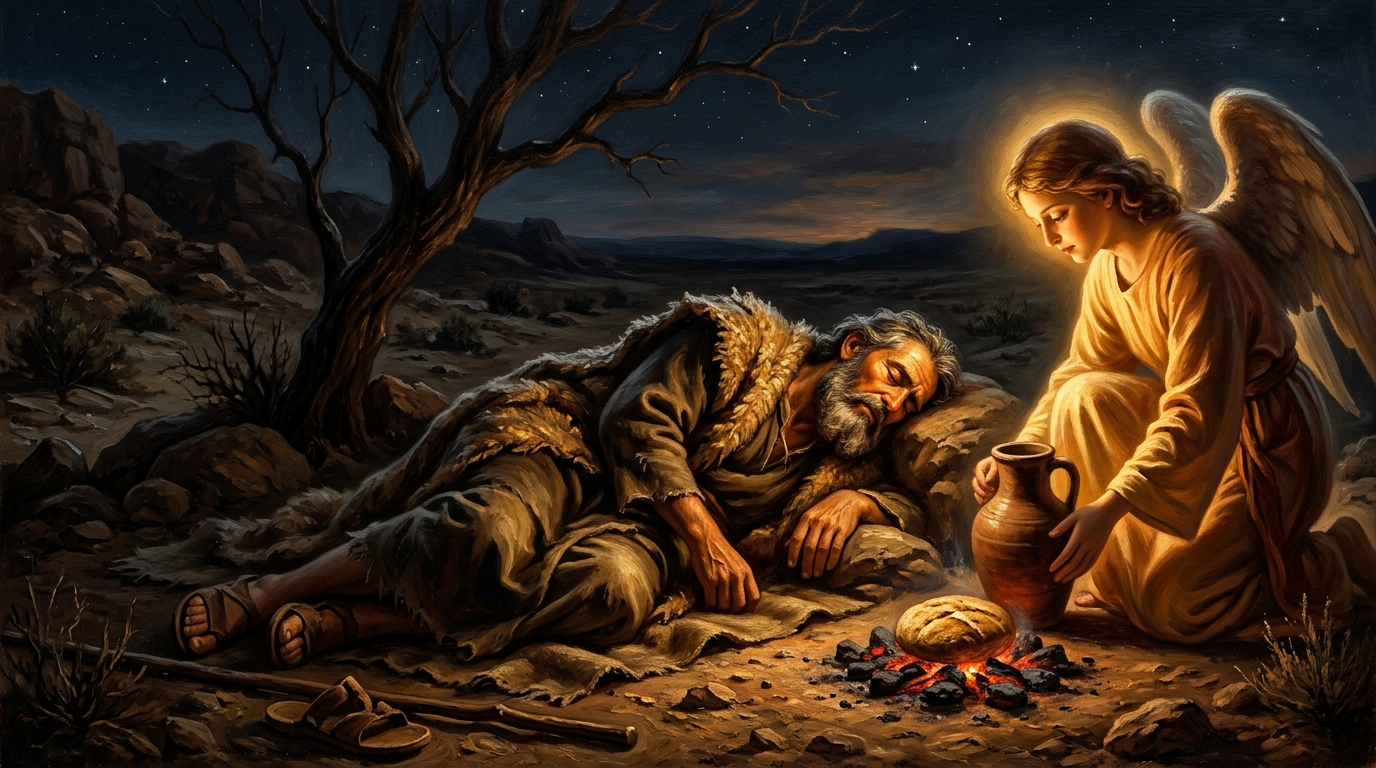
Midday desert sun hammered the chalky flats like molten brass. Elijah’s lips split open, tasting of salt dust and dried blood. Overhead arched a blinding, cloudless sky that mocked the rainstorm he had prayed down only days before. Scanning the shimmering horizon of white flint and dry wadis, his blurred eyes found only a solitary broom tree—a desert shrub whose sparse, bitter branches cast scarcely three feet of thin shade across the scorching gravel.
The spiritual giant who had shaken Israel’s throne dropped to his scraped knees and collapsed beneath that meager shadow. Pulling the scorched hem of his sheepskin mantle over his hollowed face, Elijah breathed out the rawest, most desolate prayer in the Old Testament: “It is enough now, Lord! Take my soul, for I am no better than my fathers.” He squeezed his burning eyelids shut and waited for God’s wrath to strike down a deserter—never imagining that the Almighty was about to answer his breakdown with the tenderest mercy a bruised soul had ever known.
“Then the fire of the Lord fell, and consumed the holocaust, and the wood, and the stones, and the dust, and licked up the water that was in the trench. And when all the people saw this, they fell on their faces, and they said: The Lord, he is God; the Lord, he is God.”— The First Book of Kings 18:38-39
Lord God of the prophet Elijah, You know that behind the strength we show the world and the responsibilities we carry in silence beats a frail human heart that can grow terrified, bruised, and exhausted. Look with tender mercy tonight upon all who have just come through a long battle in their family, work, or health and feel ready to whisper beneath the weight of life, 'It is enough, Lord, I cannot carry any more.' Free us from shame over our weakness, and teach us to rest safely in Your fatherly hands. Through Christ our Lord. Amen.
Biblical & Historical Questions Answered
Why did Elijah flee in terror from Queen Jezebel right after calling down fire from heaven on Mount Carmel?
How far did Elijah travel from Jezreel to the wilderness of Beersheba?
How does Catholic teaching view Elijah’s prayer asking God to take his life in 1 Kings 19:4?
Carry This Story Into Silent Prayer
Light a free 24-hour vigil candle for someone you love or rest in the candlelit 3D Chapel.