Sleep Beneath the Desert Broom Tree and Hearth Cake Baked on Glowing Stones
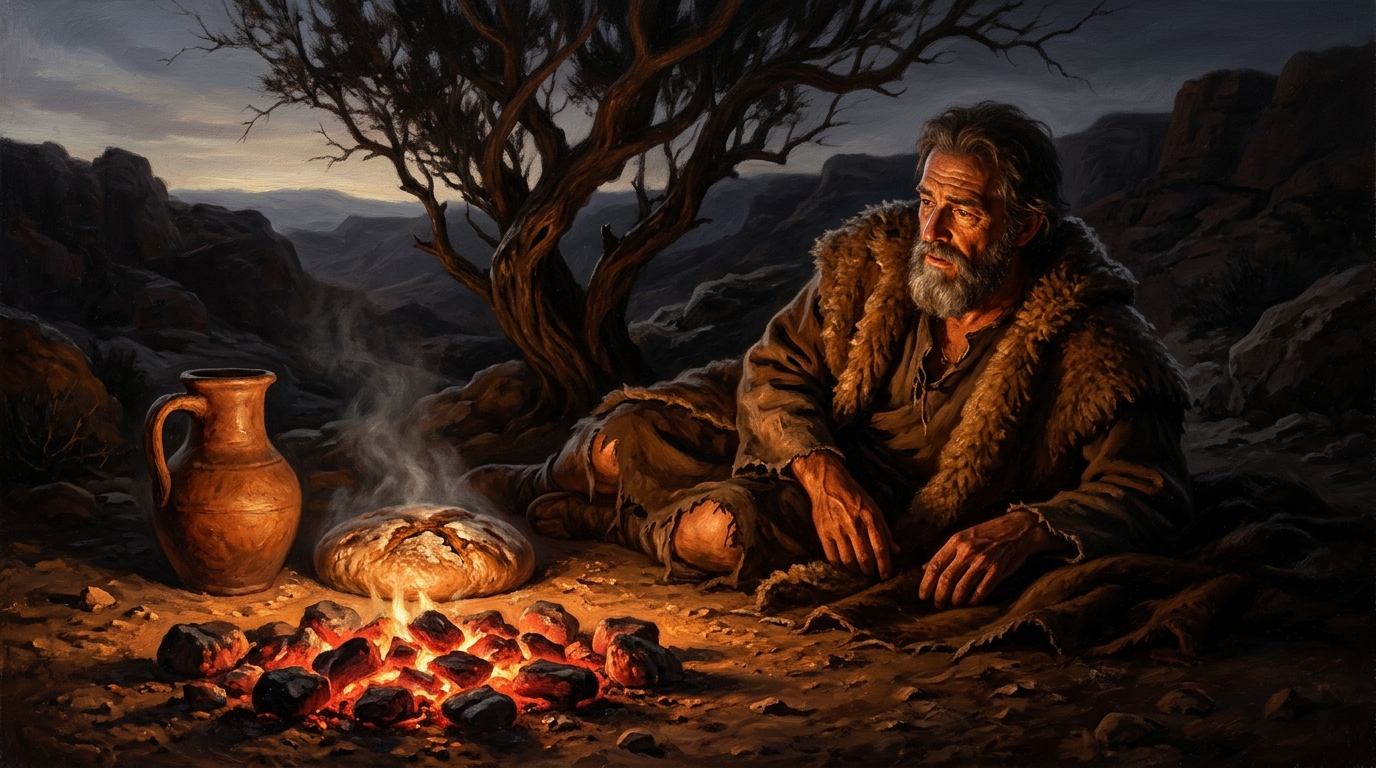
The warm aroma of barley dough sizzling on red-hot desert pebbles and cool water sweating inside a clay jar awaken the prophet curled beneath his scorched sheepskin mantle under Beersheba’s solitary broom tree.
 WORN OUT ALONE
Warm fragrance of barley dough baking on red-hot desert pebbles drifted into Elijah’s dust-caked nostrils. Out in the bleached silence of the Beersheba wilderness, where hours earlier nothing had stirred except dry wind rasping through broom-bush thorns and evening chill creeping through the scorched sheepskin mantle pulled across his chest, a gentle hand touched his shoulder. It was not the iron grip of Queen Jezebel’s executioners. Nor was it a bolt of wrath striking him down for begging God to take his life at high noon. It was a quiet, unhurried touch, tender as a mother waking an exhausted child after a brutal journey: “Arise, eat.”
Elijah’s salt-crusted eyelids fluttered open. Right beside his head, on white flint gravel that had been barren as an open grave when he collapsed, broom-root embers glowed crimson without a wisp of stinging smoke. Resting atop flat stones heated in the coals lay a round hearth cake just baked through, its golden-brown crust blistered and dusted with clean white ash. Beside the hot stones stood an earthen jar beaded with cool water in the twilight. Not one word of interrogation. Not a single stern lecture asking why the prophet of the Lord had abandoned his post in the northern kingdom.
Heaven’s First Prescription for Burnout: Uninterrupted Sleep and Warm Bread
This quiet scene in the First Book of Kings has astonished Church Fathers and spiritual masters for two millennia. When a faithful servant of God crashes into nervous exhaustion and dark despair, heaven’s first prescription is neither a theological reprimand nor a heavier Rule of prayer—it is deep, uninterrupted sleep and a hot meal. The Creator who formed man from the clay of the earth and breathed life into his nostrils knows better than any physician that a human soul cannot see straight or pray clearly while the stomach is knotted with hunger, the throat parched with thirst, and every nerve frayed by sleeplessness.
How often we treat ourselves and one another with far less mercy! Whenever exhaustion drains our warmth in prayer, whenever anxiety tightens our chest or our knees buckle under years of caregiving, we rush to accuse ourselves of spiritual cowardice and pile heavier guilt onto shoulders already bleeding. Look instead at God’s pedagogy beneath the broom tree. The Lord knew full well that Elijah’s noon cry—“It is enough now, Lord, take my soul”—did not spring from rebellion or unbelief, but from a body wrung dry after three and a half years of famine and the volcanic showdown on Mount Carmel.
Propping his trembling elbows in coarse sand, Elijah pushed himself halfway up. His calloused hands, still darkened with soot from Carmel’s altar stones, lifted the warm barley cake from the glowing pebbles. Soft, steaming crumb melted against his cracked tongue, sending warmth back into a frame chilled by shock. Tilting the clay jar, he drank long draughts of cool water down his raw throat. Yet years of cumulative exhaustion do not vanish with a single meal. Scarcely had he set the jar back in the gravel when leaden sleep dragged his eyelids shut again. Pulling the sheepskin mantle over his shoulder, Elijah lay right back down and sank into deep slumber without even managing a prayer of thanks.
The Angel’s Silent Watch Over a Wounded Prophet’s Rest
And the Lord honored that second sleep in utter silence. Long purple shadows stretched across the Negev flats as the desert stars blazed overhead. The broom tree—whose dense root-wood is prized by desert nomads because its embers hold steady heat beneath ash all night long—sheltered the prophet’s dreamless rest. No prowling jackal, no royal scout from Jezreel disturbed that sanctuary. The angel of the Lord stood quiet watch beside the wounded warrior, letting simple rest knit back together what battle had torn apart.
Only when dawn flushed the eastern limestone ridges rose-gold did the heavenly messenger’s hand touch Elijah’s shoulder a second time. The gesture carried the same gentleness, yet now the words unlocked a future: “Arise, eat: for thou hast yet a great way to go.” Two healing truths shone inside that brief sentence. First, Elijah’s life and calling had not ended beneath this desert shrub; God had neither accepted his resignation nor cast him aside for trembling. Second, the Lord acknowledged with tender realism that the road ahead was far too long for natural human stamina unless sustained by bread from heaven.
“Thou Hast Yet a Great Way to Go”: A Luminous Type of the Holy Eucharist
Across Catholic tradition, from Saint Ambrose to Saint Thomas Aquinas in his Corpus Christi hymn Lauda Sion, that “hearth cake baked on glowing stones” beneath the broom tree has been revered as one of the Old Testament’s clearest types of the Most Holy Eucharist—the true Bread of Angels and the Viaticum that sustains pilgrim believers across the wilderness of this world. Without the Bread baked upon the glowing coals of Christ’s sacrificial love on Calvary, every one of us would collapse halfway home, because the journey of fidelity exceeds our unaided strength.
Elijah rose and ate a second time. Now, as warm bread and cool water nourished a body already restored by sleep, a calm, deep-running strength—nothing like the feverish adrenaline that had driven him ahead of Ahab’s chariot—spread through his limbs. He stood upright, shook the desert grit from his sheepskin mantle, tightened his leather girdle around his waist, and strapped on his worn sandals. Blind flight driven by panic was over; a sacred pilgrimage back to the fountainhead of faith had begun.
In the strength of that food, Elijah walked forty days and forty nights across the jagged red granite gorges of the Sinai peninsula all the way to the mountain of God, Horeb. Forty days and forty nights is no casual number. Four centuries earlier, Moses had abided on that very peak of Horeb (Sinai) forty days and forty nights without eating bread or drinking water to receive the tablets of the Covenant. All Israel had likewise trekked forty years through that same wilderness learning to trust daily manna.
Forty Days and Forty Nights Back to the Covenant’s Birthplace on Mount Horeb
God was leading His exhausted prophet all the way back to the birthplace of Israel’s covenant. On Mount Carmel, Elijah had wielded fire and sword to defend the Covenant and had come away heartbroken by how quickly the crowd forgot; now he had to retrace the desert step by step to meet the Author of the Covenant Himself in the silence of the holy mountain.
When his feet finally climbed the sheer granite crags of Horeb as the fortieth evening fell, cold mountain wind whistled through the ravines. Elijah found a cave hollowed in the rock—identified by ancient Jewish and Christian tradition with the very cleft of the rock where Moses once stood shielded by God’s hand while divine glory passed by. Stepping into the cave’s dark stillness, he spread his scorched sheepskin mantle upon the stone floor for the night and waited to hear how the Almighty would speak to His runaway servant.
“And the angel of the Lord came again the second time, and touched him, and said to him: Arise, eat: for thou hast yet a great way to go.”— The First Book of Kings 19:7
Lord Jesus, Living Bread come down from heaven, in the wilderness of Beersheba You sent Your angel with hearth bread baked on glowing stones and cool water to lift the prophet Elijah from beneath the broom tree. Look mercifully upon our frailty before the long roads still stretching ahead of us. Whenever weariness brings us to our knees, touch our shoulder with Your grace, nourish us with Your Body and Blood at the altar, and teach us to offer one another the warm bread of compassion rather than cold judgment. Who live and reign forever and ever. Amen.
Biblical & Historical Questions Answered
Why did the angel wake Elijah twice to eat beneath the broom tree?
How does Catholic tradition connect Elijah’s hearth cake in 1 Kings 19 with the Holy Eucharist?
Why did Elijah walk for forty days and forty nights to reach Mount Horeb?
Carry This Story Into Silent Prayer
Light a free 24-hour vigil candle for someone you love or rest in the candlelit 3D Chapel.